How to Calculate the True Cost of Bundling Products Across Marketplaces and Whether It Improves or Erodes Net Margin
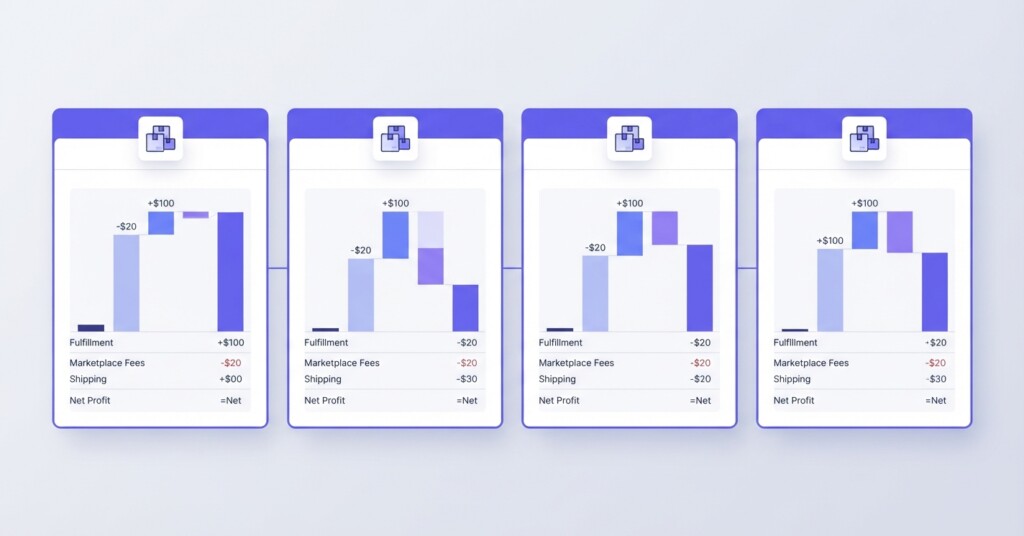
Bundling products sounds like a straightforward margin lever: combine two or three SKUs, offer a slight discount, and watch average order value climb. But when you are selling the same bundle across Shopify, Shopee, Lazada and TikTok Shop simultaneously, the financial reality is considerably more complex. Each channel applies its own commission structure, fulfilment logic and promotional contribution requirement — meaning a bundle that earns you 18% net margin on your own store may actually lose money on a marketplace.
This article walks through how to calculate the true per-channel cost of a product bundle, identify whether bundling genuinely improves contribution margin, and build a framework you can apply to any SKU combination across your sales channels.
Why Standard Bundle Margin Calculations Fall Short
Most operators calculate bundle margin using a simple formula: bundle selling price minus the combined cost of goods sold (COGS). This is a useful starting point, but it ignores several cost layers that compound quickly across marketplaces.
Consider a skincare brand selling a cleanser (COGS: $6.00) and a moisturiser (COGS: $9.00) as a bundle priced at $28.00. On the surface, the gross margin looks like: ($28.00 − $15.00) ÷ $28.00 = 46.4%. That looks healthy. But once you layer in platform fees, fulfilment, packaging, and any seller-funded vouchers or coinback contributions, the picture changes substantially.
The core principle: every sales channel has a different cost structure, and a bundle’s profitability must be calculated at the channel level — not at the product or category level alone. A bundle that works on Shopify may erode margin on Shopee once platform fees, fulfilment and promotional contributions are factored in.
The Full Cost Stack for a Marketplace Bundle
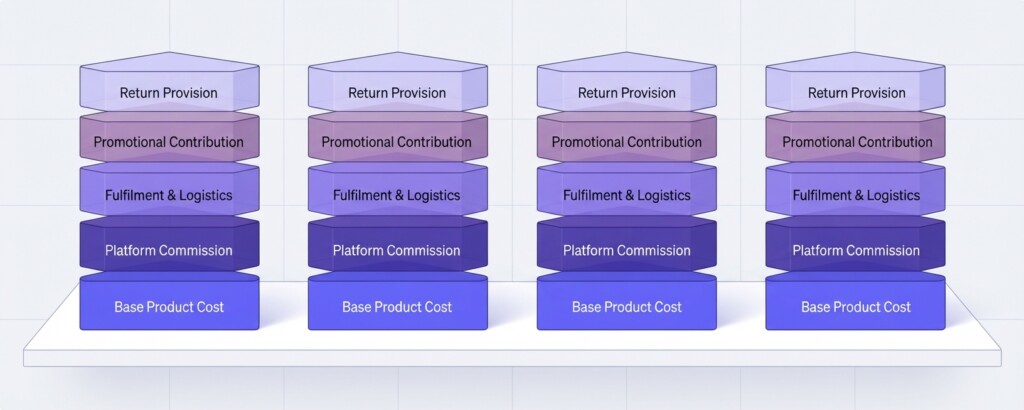
To calculate true bundle profitability on any channel, you need to build what is often called a ‘cost stack’ — every deduction applied between the customer’s payment and the cash that actually reaches your account. Here is the full list of costs you should include:
- Combined COGS of all SKUs in the bundle
- Inbound freight and warehousing allocation per unit
- Bundle packaging and kitting labour cost
- Platform commission (percentage of gross merchandise value)
- Payment processing or transaction fee (frequently charged as a separate line item from commission across platforms)
- Fulfilment or shipping subsidy cost (seller-borne portion)
- Seller-funded voucher or discount contribution
- Coinback or loyalty programme contribution required by platform
- Return provision (estimated returns as a percentage of revenue)
- Allocated marketing spend attributed to the bundle listing (e.g. sponsored ads)
A Worked Example: Skincare Bundle Across Four Channels
Let us build a realistic calculation for the skincare bundle described above. The bundle sells at $28.00 across all four channels. COGS is $15.00. Kitting and packaging adds $1.20 per unit. Inbound freight allocation is $0.60 per unit. That gives us a base cost of $16.80 before any channel-specific fees.
| Cost Item | Shopify | Shopee | Lazada | TikTok Shop |
|---|---|---|---|---|
| Bundle selling price | $28.00 | $28.00 | $28.00 | $28.00 |
| COGS (combined SKUs) | $15.00 | $15.00 | $15.00 | $15.00 |
| Kitting & packaging | $1.20 | $1.20 | $1.20 | $1.20 |
| Inbound freight allocation | $0.60 | $0.60 | $0.60 | $0.60 |
| Platform commission | $0.84 (3%) | $3.08 (11%) | $3.36 (12%) | $3.08 (11%) |
| Payment processing | $0.81 (2.9%) | Included | Included | Included |
| Shipping subsidy (seller portion) | $0.00 | $1.50 | $1.80 | $1.20 |
| Promotional contribution (vouchers/coinback) | $0.00 | $1.40 | $1.12 | $1.68 |
| Return provision (3% of revenue) | $0.84 | $0.84 | $0.84 | $0.84 |
| Attributed ad spend per unit | $1.40 | $0.70 | $0.84 | $1.12 |
| Total costs | $20.69 | $24.32 | $24.76 | $24.72 |
| Net margin ($) | $7.31 | $3.68 | $3.24 | $3.28 |
| Net margin (%) | 26.1% | 13.1% | 11.6% | 11.7% |
The same bundle, the same price, the same product — but net margin ranges from 26.1% on Shopify down to 11.6% on Lazada. This is not a marginal difference. If your business target is a minimum 15% net margin, this bundle is underperforming on three of four channels. The question is: does the bundle at least outperform selling the individual SKUs separately?
Does Bundling Actually Improve Margin? The Comparison Test
To answer this, you need to model the counterfactual: what would net margin look like if the cleanser and moisturiser were sold individually rather than as a bundle? This requires the same cost stack applied to each SKU at its standalone price.
Assume the cleanser sells individually at $14.00 and the moisturiser at $18.00. The bundle is priced at $28.00, which represents a 12.5% discount versus purchasing both individually. The bundle drives higher average order value but reduces revenue per pair of units sold. On Shopee specifically:
| Individual cleanser net margin on Shopee (estimated) | $1.42 |
| Individual moisturiser net margin on Shopee (estimated) | $2.61 |
| Combined net margin if sold separately | $4.03 |
| Bundle net margin on Shopee | $3.68 |
| Margin erosion from bundling on Shopee | −$0.35 per transaction |
In this example, bundling on Shopee slightly erodes net margin compared to selling the items separately. The bundle may still be strategically valuable — it can improve conversion rates, reduce per-order fulfilment costs when shipping one parcel versus two, and increase basket size — but the pure margin arithmetic does not favour it.
Do not assume that a higher bundle price automatically means higher profit. The discount you offer to incentivise bundle purchase, combined with platform promotional contribution requirements, can easily push net margin below what you would have earned selling SKUs individually. Always run the comparison calculation before activating bundles on marketplace channels.
When Bundling Does Improve Net Margin
- The bundle includes a high-margin accessory or consumable that would rarely be purchased alone — the bundle lifts attachment rate without cannibalising a standalone sale.
- Fulfilment cost per unit is meaningfully lower when two items ship together versus separately — this saving must be quantified and factored into the model.
- The bundle qualifies for a platform programme or logistics tier that reduces commission rates or unlocks fulfilment credits — though sellers should note that standard Shopee Mall and LazMall tiers actually carry higher commission rates than regular marketplace listings.
- The bundle price premium over individual SKUs is maintained — meaning the discount versus buying separately is small (under 8%), preserving most of the revenue benefit.
- The bundle reduces return rates because complementary products used together generate better customer outcomes — a measurable reduction in return provision improves net margin.
Building a Bundle Profitability Scorecard
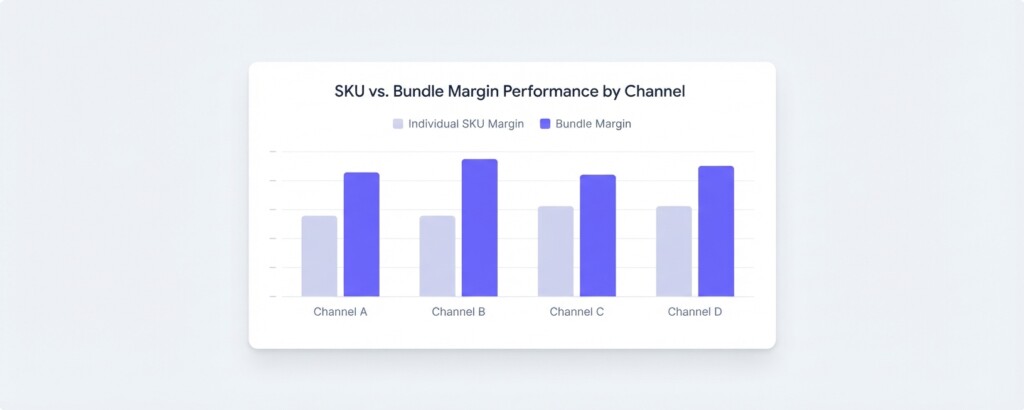
Rather than running ad hoc calculations, build a reusable scorecard for every bundle you consider. The scorecard should produce three outputs for each channel: gross margin, contribution margin (after fulfilment and promotional costs), and net margin (after attributed ad spend and return provision).
If you are managing a catalogue of 50 or more active bundles across multiple channels, doing this manually in spreadsheets becomes error-prone. Tools that connect to your marketplace data feeds and calculate per-SKU and per-bundle contribution margin automatically — such as BrizoMarket — reduce the time required and ensure the numbers stay current as platform fee structures change.
The scorecard framework should include: bundle name and constituent SKUs, channel, selling price, COGS, all variable costs itemised, gross margin, contribution margin, net margin, minimum viable price to hit target margin, and a pass or flag status. Review the scorecard monthly or whenever a platform updates its fee schedule.
Pricing Bundles to Hit a Target Margin by Channel
One of the most practical applications of this framework is working backwards from your target net margin to determine the minimum bundle price on each channel. If you require 15% net margin, and you know the total cost stack on Lazada is $24.76 for this bundle, your minimum viable price is: $24.76 ÷ (1 − 0.15) = $29.13.
If the market will not support $29.13 on Lazada — because competitor bundles are priced at $26 or $27 — you have a clear decision: either absorb a below-target margin, reduce costs within the stack (negotiate packaging, adjust ad spend), or simply not offer the bundle on that channel. This is a strategic call, not a margin calculation error.
| Channel | Total Cost Stack | Minimum Price at 15% Net Margin | Current Bundle Price | Margin Status |
|---|---|---|---|---|
| Shopify | $20.69 | $24.34 | $28.00 | ✓ Above target |
| Shopee | $24.32 | $28.61 | $28.00 | ✗ Below target |
| Lazada | $24.76 | $29.13 | $28.00 | ✗ Below target |
| TikTok Shop | $24.72 | $29.08 | $28.00 | ✗ Below target |
This table makes the decision tangible. The bundle only meets the 15% net margin target on Shopify. On the three marketplace channels, the operator has three options: raise the bundle price (if competitive positioning allows), reduce the cost stack (by renegotiating fulfilment or reducing promotional contributions), or accept a lower margin strategically in exchange for volume and visibility.
Common Mistakes When Evaluating Bundle Profitability
- Using blended average fees rather than channel-specific rates — Shopee and Lazada commission rates vary by category and seller tier.
- Forgetting kitting and assembly labour — if bundles are assembled in-house, there is a real labour cost per unit that must be allocated.
- Excluding promotional contributions — platform campaigns such as double-day sales often require mandatory voucher contributions that are deducted from settlement.
- Not comparing bundle margin against selling SKUs individually — the relevant benchmark is not ‘is this bundle profitable?’ but ‘does this bundle outperform the alternative?’
- Applying a single return rate to all bundles — bundles that contain fragile or complex products may have structurally higher return rates.
- Ignoring the impact of bundle listings on individual SKU velocity — if bundling a hero SKU pulls customers away from the standalone listing, blended category margin may fall.
Practical Next Steps
Start with your five highest-volume bundles and build the full cost stack for each channel where they are listed. Use actual settlement data from each platform to validate your commission and fee assumptions — the numbers from your seller centre will differ from headline rates once tier adjustments, promotional contributions and coinback deductions are applied.
Set a minimum contribution margin threshold per channel — not just a gross margin target — and flag any bundle that falls below it. Review quarterly, or immediately when a platform announces fee structure changes. If a bundle persistently underperforms on a specific channel, either reprice it or delist it. The goal is not maximum product variety across every channel; it is maximum margin efficiency from the combinations that genuinely work.
Bundling can be a powerful margin lever when structured correctly. But it can equally erode profitability if implemented without rigorous per-channel cost analysis. The operators who get this right build their bundle strategy around the numbers, not assumptions.
Track Bundle Profitability Across Every Channel
BrizoMarket helps multi-channel ecommerce operators calculate true net margin at the SKU and bundle level across Shopify, Shopee, Lazada and TikTok Shop — with all fees, fulfilment costs and promotional contributions factored in.