How to Calculate the True Cost of Storing Slow-Moving Inventory Across Your 3PL and Marketplace Fulfilment Centres

Slow-moving inventory is one of the most expensive problems in e-commerce — and one of the least visible. While you are focused on driving sales across Shopify, Shopee, Lazada and TikTok Shop, a portion of your stock may be quietly consuming cash, warehouse space and margin without generating a single order. The challenge is that the true cost of holding that inventory is almost never captured in a single line on your P&L.
This article walks through how to calculate the full holding cost of slow-moving inventory across your 3PL and marketplace fulfilment centres, so you can make informed decisions about whether to discount, liquidate, withdraw or replenish.
Why Standard Inventory Reports Understate the Real Cost
Most e-commerce operators track inventory value on hand and perhaps a basic days-of-stock metric. What they rarely calculate is the total economic cost of keeping that inventory in storage — particularly across multiple fulfilment locations that each have different fee structures.
A 3PL warehouse typically charges a monthly storage fee per pallet, cubic metre or bin location. Marketplace fulfilment centres like Fulfilment by Lazada (FBL) or Shopee’s integrated logistics hubs charge long-term storage fees once inventory exceeds a defined duration threshold. These fees compound over time, and when you add the opportunity cost of tied-up capital, the true cost of a slow-moving SKU can be two to three times what appears on your storage invoice.
The true cost of slow-moving inventory is not just what you pay in storage fees. It includes the cost of the capital tied up in that stock, the margin you are losing by not redeploying that cash, and the fulfilment complexity of managing units spread across multiple locations.
The Components of True Inventory Holding Cost
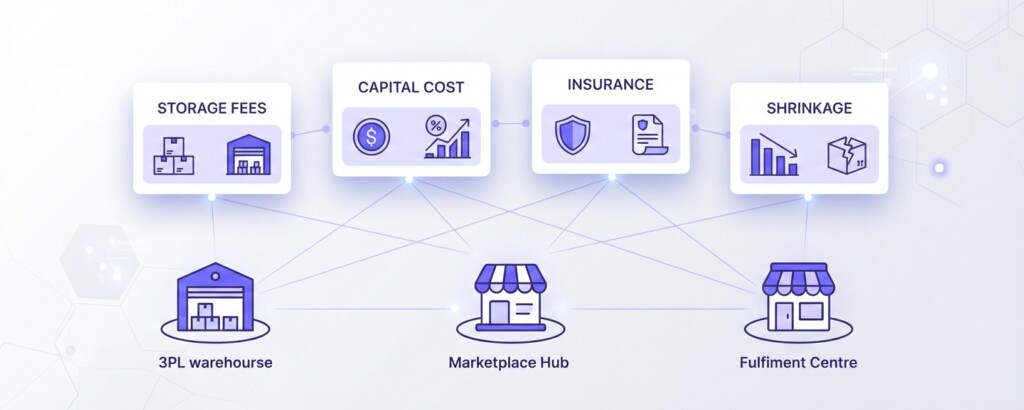
To calculate accurately, you need to identify every cost component associated with keeping a unit in storage. These fall into four categories:
- Physical storage fees charged by your 3PL or marketplace fulfilment centre
- Capital cost of the inventory (the opportunity cost of cash tied up in stock)
- Insurance and shrinkage provisions
- Labour and administration costs associated with managing and counting that inventory
For most e-commerce businesses, the first two components dominate. The capital cost is frequently ignored because it does not appear on an invoice, but if you are running your business with working capital from a credit facility or if that cash could be reinvested in faster-moving product, it is a real economic cost.
Step-by-Step: Building Your Holding Cost Calculation
The following example uses a realistic scenario. You sell a skincare bundle across Shopify (fulfilled from a 3PL), Shopee (seller-fulfilled with stock at your own warehouse), and Lazada (stock pushed into Lazada Fulfilment). You have 400 units of a slow-moving SKU split across these locations. The landed cost per unit is $18.00.
Step 1 — Identify Storage Fees Per Location
Pull your storage fee schedule from each fulfilment partner. 3PL fees are typically quoted per pallet per month or per cubic metre per month. Marketplace fees vary. For this example:
| Location | Units Stored | Storage Fee Basis | Monthly Fee |
|---|---|---|---|
| 3PL (Shopify fulfilment) | 200 units | $0.50 per cubic metre per day, SKU occupies 2 cbm | $30.00 |
| Lazada Fulfilment Centre | 150 units | $0.08 per unit per week (long-term threshold exceeded) | $48.00 |
| Own warehouse (Shopee) | 50 units | Allocated rent + utilities: $0.20 per unit per month | $10.00 |
Total monthly storage fees across all locations: $88.00 for this one SKU. Annualised, that is $1,056 per year just in storage charges — before you count a single dollar of capital cost.
Step 2 — Calculate the Capital Cost of Tied-Up Stock
This is the cost most operators miss. You have 400 units at a landed cost of $18.00 each, so $7,200 of capital is sitting in this SKU. If your cost of working capital is 12% per annum (a conservative estimate if you are using a credit facility or trade financing), then:
| Inventory value (400 units × $18.00) | $7,200.00 |
| Annual capital cost rate | 12% |
| Annual capital cost | $864.00 |
| Monthly capital cost | $72.00 |
Even if you are not using external financing, this represents the opportunity cost of capital that could be reinvested into faster-turning inventory or used to fund marketing that generates immediate returns.
Step 3 — Add Ancillary Costs
Depending on your operation, you may also carry:
- Insurance: typically 0.1–0.3% of inventory value per month
- Inventory counting and admin time: estimate the internal labour cost of cycle counts and reconciliation for this SKU across locations
- Removal or disposal fees if you eventually need to retrieve or write off the stock
For this example, we apply a conservative 0.15% per month insurance and shrinkage provision on the inventory value ($7,200 × 0.15% = $10.80 per month).
Step 4 — Compile Your Total Monthly Holding Cost
| 3PL storage fee | $30.00 |
| Lazada Fulfilment storage fee | $48.00 |
| Own warehouse (Shopee allocation) | $10.00 |
| Capital cost (opportunity cost) | $72.00 |
| Insurance and shrinkage provision | $10.80 |
| Total monthly holding cost | $170.80 |
Annualised, the cost of holding this single slow-moving SKU across three locations is approximately $2,050. Against a landed inventory value of $7,200, that is a holding cost rate of 28% per annum — well above what most operators assume when they think about ‘storage fees.’
Calculating Holding Cost Per Unit and Per Channel
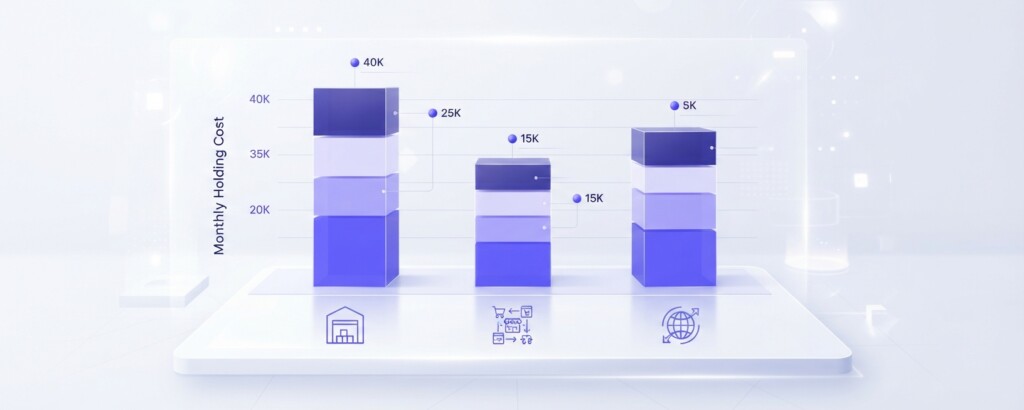
Once you have your total monthly holding cost, translate it into a per-unit figure. With 400 units and a monthly holding cost of $170.80, you are paying $0.43 per unit per month to hold this SKU. If a unit sits for six months without selling, that is $2.57 added to its effective cost — on top of the $18.00 you already paid.
This matters significantly when you are setting prices or considering whether to run a promotional discount. A 20% markdown on a product selling at $35.00 brings the sale price to $28.00. After the $18.00 landed cost and $2.57 accumulated holding cost, your contribution margin per unit is $7.43 before fulfilment and platform fees. Run the same numbers at six months without a discount and you may find the product never sells at all, resulting in a full write-off.
Marketplace fulfilment centres often apply escalating long-term storage fees once inventory has been held beyond a threshold (commonly 90 or 180 days). These fees can increase rapidly and are frequently overlooked until the invoice arrives. Review your fulfilment centre fee schedules monthly and flag any SKU approaching the threshold.
Comparing the Holding Cost Impact Across Channels
The same SKU can have very different holding cost profiles depending on where it is stored. This affects how you should allocate inventory and prioritise sell-through on each channel.
| Channel | Units | Monthly Storage Fee | Capital Cost Share | Total Monthly Cost | Cost Per Unit/Month |
|---|---|---|---|---|---|
| Shopify via 3PL | 200 | $30.00 | $36.00 | $71.40 | $0.36 |
| Lazada Fulfilment | 150 | $48.00 | $27.00 | $79.05 | $0.53 |
| Shopee (own warehouse) | 50 | $10.00 | $9.00 | $20.35 | $0.41 |
In this scenario, the Lazada Fulfilment units carry the highest holding cost per unit — primarily because the long-term storage fee has kicked in. If sell-through on Lazada is slower than on Shopify, it may be worth pulling stock back from Lazada Fulfilment once the threshold is approaching, or running a targeted promotion specifically on that channel to clear units before fees escalate.
What to Do With the Numbers
Once you have a clear holding cost figure, you can plug it into four practical decisions:
- Discount threshold analysis: Determine the minimum viable selling price that still recovers your landed cost plus accumulated holding cost plus fulfilment and platform fees. Any price above this threshold is better than continued storage.
- Channel reallocation: If sell-through is faster on TikTok Shop or Shopify than on Lazada, shift inventory toward the channels with higher velocity before long-term storage fees accumulate.
- Liquidation vs. continued holding: Compare the net recovery from a clearance sale or bulk liquidation against the projected holding cost over the next 90–180 days. If holding costs exceed the incremental margin from waiting, liquidate sooner.
- Write-off timing: If a SKU has been slow-moving for more than 90 days, model the full-year holding cost and compare it to the inventory value. A timely write-off decision is preferable to paying holding costs indefinitely on stock that will never sell at an acceptable margin.
Using Analytics to Track This at Scale
Doing this calculation manually for one SKU is achievable. Doing it across hundreds of SKUs and multiple fulfilment locations every month is where most finance teams fall short. The data you need — inventory levels by location, storage fee invoices, landed cost per SKU, days in storage — typically sits across your 3PL portal, your marketplace seller centres, and your accounting system. It rarely comes together automatically.
Platforms like BrizoMarket are designed to pull this kind of multi-channel inventory and cost data into one view, so you can see contribution margin and holding costs by SKU and by channel without manually reconciling spreadsheets each month. When you can see which products are eroding margin through accumulating storage costs rather than just sitting at zero sales, the decisions become much clearer.
Key Takeaways and Practical Next Steps
Slow-moving inventory does not simply sit still — it actively erodes margin every month. The operators who manage this well are those who treat holding cost as a real, calculated number rather than a vague concern about ‘too much stock.’
- Pull your storage fee schedules from every 3PL and marketplace fulfilment centre and confirm whether long-term storage fee thresholds apply and when they trigger.
- Identify your top 20 slowest-moving SKUs by days-of-stock and calculate their monthly holding cost using the four-component model: storage fees, capital cost, insurance and shrinkage, and administration.
- Set a holding cost alert threshold — for example, any SKU where accumulated holding cost has exceeded 15% of its landed inventory value should trigger a review and decision.
- Run a channel-by-channel sell-through comparison to identify where velocity is lowest and whether a targeted promotion or stock reallocation could reduce holding cost before fees escalate.
- Schedule a monthly inventory review using this framework rather than relying solely on a standard stock-on-hand report.
Track Holding Costs Across Every Channel in One Place
BrizoMarket helps e-commerce operators and finance managers connect multi-channel sales, inventory and cost data so you can calculate true product profitability and act on slow-moving stock before it erodes your margins.