How to Use Shopee Seller Centre Search Analytics to Measure Which Keywords Drive the Highest Revenue per Click Across Your Catalogue
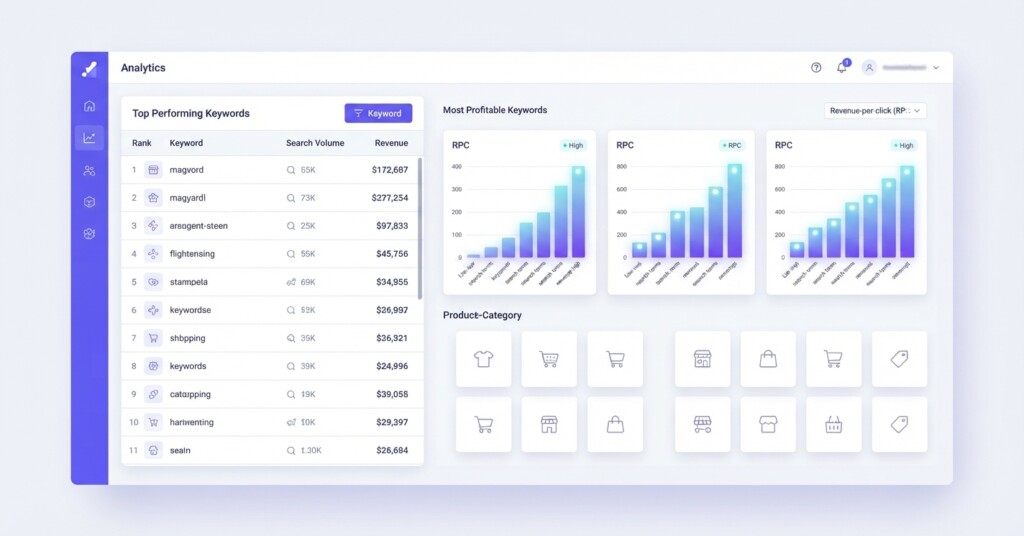
If you sell across Shopee, Shopify, Lazada or TikTok Shop, you already know that not all traffic is equal. A keyword that generates ten thousand impressions but zero conversions is a cost, not an asset. The more useful question — and the one most sellers never ask — is which keywords are actually generating the highest revenue for every click they receive. Shopee Seller Centre gives you enough raw data to answer this, but it requires a structured approach to extract anything actionable from it.
This article walks through how to use Shopee’s search and advertising analytics to calculate revenue per click (RPC) at the keyword level, how to connect that data to your product margins, and how to use the findings to allocate your promotional and advertising budget more precisely across your catalogue.
What Search Analytics Shows You in Shopee Seller Centre
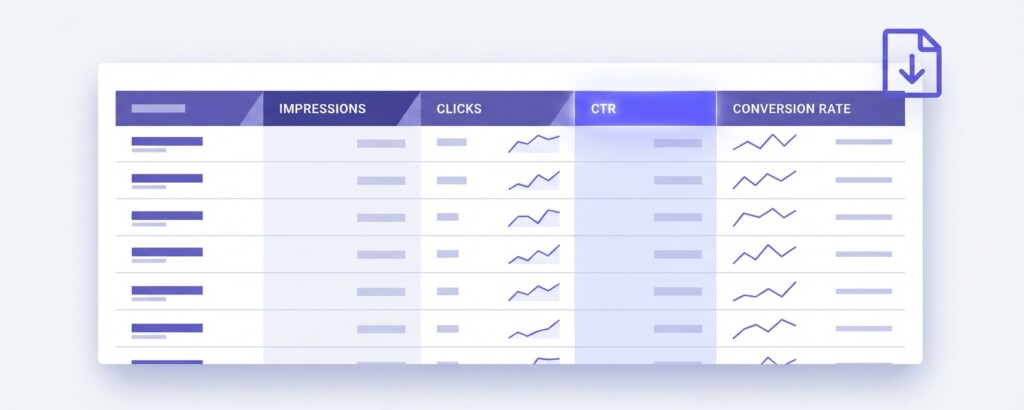
In Shopee Seller Centre, search and listing analytics are split across Business Insights and Shopee Ads. While the ‘Business Insights’ tab provides aggregate shop traffic channels and SKU-level metrics (such as page views, visitors, and conversion rate under Product Performance), granular keyword data — including impressions, clicks, click-through rate (CTR), and conversions — is tracked through Search Ads under Marketing Centre → Shopee Ads.
What it does not give you directly is revenue per click. You have to construct that figure yourself by combining the keyword data with your product pricing and conversion data. This is a one-step calculation that most sellers skip, which is why so many Shopee advertising campaigns optimise for impressions or CTR rather than actual revenue generated.
Revenue per Click (RPC) = (Keyword Conversion Rate × Average Order Value) for the products that keyword surfaces. It tells you how much gross revenue each click on that keyword is worth in expectation.
Step One: Export Your Keyword Data
Start by navigating to Seller Centre → Marketing Centre → Shopee Ads, then access your Product Search Ads reports. Set your date range to at least 30 days to smooth out day-to-day volatility. Export the keyword data to CSV. Your export should contain, at minimum, the following columns: keyword, impressions, clicks, CTR, and — depending on your campaign setup — orders, conversion rate, or GMV.
If you are evaluating search terms without direct keyword-level order attribution, you can approximate the conversion rate by cross-referencing the keyword with the product listing it most commonly surfaces. Use the product’s overall session-to-order conversion rate from Business Insights → Product Performance as a proxy. This is an approximation, not a precise figure, but it is good enough to rank keywords by relative performance.
Step Two: Map Keywords to Products and Assign Revenue Values
Each keyword in your export surfaces one or more of your listings. For multi-product catalogues, the same keyword might lead to different listings depending on how Shopee’s algorithm ranks them on any given day. For this analysis, start by focusing on keywords where a single product dominates — these give you a clean mapping between keyword and revenue outcome.
For each keyword, record the primary product it surfaces, that product’s selling price, and the product’s average conversion rate. You now have everything you need to calculate RPC.
| Keyword: 'stainless water bottle 500ml' — Clicks (30 days) | 1,240 |
| Conversion Rate (product-level proxy) | 3.8% |
| Estimated Orders from Keyword | 47 |
| Average Selling Price | $18.90 |
| Estimated Keyword Revenue | $888.30 |
| Revenue per Click (RPC) | $0.72 |
Repeat this for every keyword in your export. Once you have an RPC value for each keyword, you can rank them. The ranking is far more useful than sorting by impressions or even by click volume alone.
Step Three: Build a Keyword Revenue Performance Table
The table below shows how this analysis might look for a hypothetical seller of kitchen and lifestyle products, with five keywords evaluated side by side. Notice how the highest-impression keyword is not the highest RPC keyword — a pattern that appears repeatedly in real catalogues.
| Keyword | Impressions | Clicks | CTR | Conv. Rate | Avg. Price | Est. Revenue | RPC |
|---|---|---|---|---|---|---|---|
| stainless water bottle | 84,000 | 2,100 | 2.5% | 2.9% | $18.90 | $1,153 | $0.55 |
| 500ml insulated bottle | 12,400 | 620 | 5.0% | 5.1% | $18.90 | $597 | $0.96 |
| kitchen knife set | 61,000 | 1,830 | 3.0% | 1.8% | $34.50 | $1,138 | $0.62 |
| chef knife 8 inch | 9,800 | 490 | 5.0% | 6.2% | $34.50 | $1,048 | $2.14 |
| lunch box bento | 45,000 | 900 | 2.0% | 1.4% | $12.50 | $158 | $0.18 |
The keyword ‘chef knife 8 inch’ generates more than four times the revenue per click of the high-impression ‘stainless water bottle’ term. If you were allocating Shopee Ads budget based on impression volume alone, you would systematically underfund your most profitable keyword traffic.
Why RPC Alone Is Not Enough — Add Margin to the Analysis
Revenue per click tells you which keywords generate the most top-line value. But for businesses managing thin margins across multiple channels, what you actually want is gross profit per click (GPPC). A high-RPC keyword attached to a low-margin product may be less valuable than a moderate-RPC keyword on a high-margin SKU.
To calculate GPPC, multiply your RPC by the gross margin percentage of the product the keyword primarily surfaces. Using the chef knife example: if the 8-inch chef knife has a gross margin of 42% after cost of goods, Shopee commission (typically around 3–6% base commission depending on category and seller tier), and packaging, then:
| RPC — 'chef knife 8 inch' | $2.14 |
| Gross Margin % (after COGS, platform fee, packaging) | 42% |
| Gross Profit per Click (GPPC) | $0.90 |
Compare this to your Shopee Ads cost per click (CPC) for the same keyword. If your CPC is $0.15, your contribution after advertising is $0.75 per click — a strong return. If a competitor has bid up CPC to $0.95 for a broadly matched version of that term, the economics deteriorate rapidly. This is exactly the kind of analysis you need before scaling ad spend on any keyword.
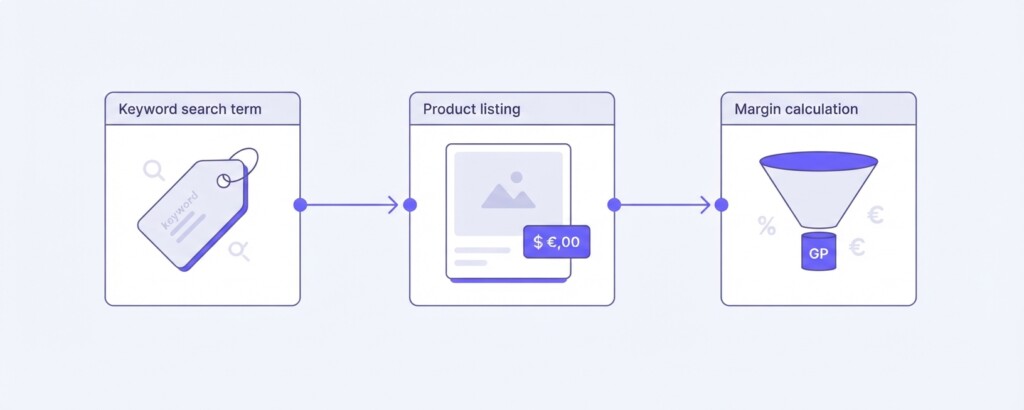
Do not optimise keyword bids purely on RPC without factoring in product margin. A keyword driving revenue on a 12% margin product can destroy contribution margin at aggressive CPC levels, even if the revenue number looks impressive in your Seller Centre dashboard.
Applying This Across a Multi-Channel Catalogue
If you operate across Shopee, Lazada and TikTok Shop simultaneously — a common structure for Southeast Asian e-commerce businesses — keyword performance on Shopee is not necessarily transferable across channels. Each platform has its own search algorithm, buyer intent profile and commission structure, which affects what a click is actually worth.
A term like ‘bento lunch box’ may convert at 1.4% on Shopee but perform substantially differently on TikTok Shop where the buyer intent is shaped by video content rather than keyword search. The RPC framework is channel-specific. The underlying product margin remains constant, but the revenue a click generates — and the cost of that click — varies by platform.
When comparing channels, the useful cross-channel metric is contribution margin per order, which accounts for channel-specific fees, advertising costs and returns rates. This lets you evaluate whether your highest-RPC Shopee keywords are genuinely your best-performing traffic, or whether a lower-volume TikTok Shop campaign on the same SKU is actually delivering superior unit economics.
Prioritisation Framework: How to Act on Your Keyword RPC Data
Once you have RPC and GPPC calculated for your top keywords, segment them into four categories for action:
- High RPC, High Margin — Scale: These are your priority keywords. Increase Shopee Ads bids, ensure listing SEO is fully optimised, and check that inventory is sufficient to handle increased traffic without stockout risk.
- High RPC, Low Margin — Monitor carefully: Revenue is strong but profit is thin. Set a CPC ceiling based on your GPPC and avoid bidding wars. Consider whether bundling or upselling can improve the margin profile of orders from this keyword.
- Low RPC, High Margin — Investigate: These keywords may be attracting browsers rather than buyers. Review your listing content, main image and pricing relative to competitors surfacing for the same term. A listing improvement may unlock latent margin.
- Low RPC, Low Margin — Deprioritise: Reduce or pause Shopee Ads spend on these keywords. If they are generating organic impressions, leave them, but do not pay to amplify low-value, low-margin traffic.
Using Tools to Scale the Analysis
For sellers with catalogues of twenty or fewer SKUs, this analysis is manageable in a spreadsheet. For operators running hundreds of listings across multiple channels, manually mapping keywords to products and calculating GPPC at scale becomes impractical without some form of data consolidation.
Platforms like BrizoMarket are designed to help multi-channel sellers connect sales data, margin data and channel costs in one place, making it possible to evaluate keyword and product performance across Shopee, Lazada, TikTok Shop and Shopify without maintaining separate spreadsheets for each channel. The core logic — calculating revenue and profit per click at the keyword level — remains the same whether you do it manually or through a tool. The difference is how quickly you can act when the data changes.
Practical Next Steps
Here is a concise action checklist to implement this analysis in your business this week:
- Export 30-day keyword performance data from Shopee Ads (under Marketing Centre).
- Map each keyword to its primary product listing.
- Pull conversion rate and average selling price for each associated product from Business Insights → Product Performance.
- Calculate RPC for each keyword using the formula: Conversion Rate × Average Selling Price.
- Layer in gross margin per product to derive Gross Profit per Click.
- Compare GPPC to your actual or target CPC for each keyword.
- Segment keywords into the four priority categories and adjust Shopee Ads bids accordingly.
- Repeat the analysis monthly to track how keyword economics shift with competition and seasonality.
The sellers who consistently outperform on Shopee are not necessarily those with the largest ad budgets. They are the ones who understand which clicks are actually worth paying for. Building a keyword RPC and GPPC framework gives you the analytical foundation to make that judgment with precision rather than instinct.
Analyse Your Keyword and Channel Performance in One Place
BrizoMarket helps multi-channel e-commerce businesses connect sales, margin and advertising data across Shopee, Lazada, TikTok Shop and Shopify — so you can see exactly which keywords, products and channels are driving real profit.