How to Determine the Right Price for Each Channel When Marketplace Fee Structures Force Different Margin Thresholds
If you sell the same product on Shopify, Shopee, Lazada and TikTok Shop, you are almost certainly leaving money on the table — or worse, actively losing it on some channels without realising. Each platform carries a different cost structure: commission rates, payment processing fees, promotional participation costs and fulfilment charges all vary. When you charge the same retail price everywhere, you end up with wildly different contribution margins depending on where the sale lands. The fix is channel-specific pricing, built on a clear understanding of what each channel actually costs you.
This article walks through how to calculate the true cost of selling on each channel, how to set a floor price that protects your margins, and how to decide whether a price difference between channels is commercially justifiable or a signal that a channel is not worth running at current volumes.
Why the Same Price Produces Different Margins on Every Channel
Consider a skincare brand selling a serum at a retail price of $45. On its own Shopify store, the contribution margin might be a healthy 60%. On Shopee, once the platform commission, transaction fee, free-shipping subsidy and mandatory voucher contribution are deducted, the same $45 price might yield a margin closer to 35%. On TikTok Shop, where creator affiliate commissions stack on top of platform fees, the margin could compress further still.
These are not minor rounding differences. A 25-percentage-point swing in contribution margin on a $45 product is the difference between a profitable channel and one that destroys value at scale. The root cause is that most operators think about price as a single number rather than a channel-specific output from a margin calculation.
Step Two: Build a Full Cost Stack for Each Channel
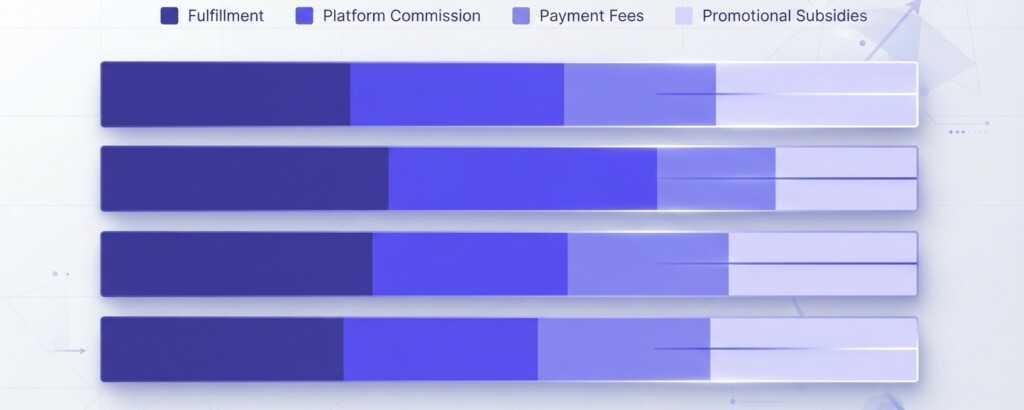
Before you can set a price, you need to know what it costs to fulfil a sale on each channel. The cost stack has four layers.
- Cost of Goods Sold (COGS): The landed unit cost including manufacturing, inbound freight and any import duties.
- Fulfilment cost: Pick, pack, outbound shipping and, where applicable, platform-managed logistics fees such as Lazada Logistics or Shopee Xpress.
- Platform fees: Commission percentage, payment processing fee, and any fixed monthly seller fees allocated per unit at expected volume.
- Variable sales costs: Affiliate or creator commissions (critical on TikTok Shop), mandatory voucher contributions, flash-sale subsidies, and promotional coin cashback that the seller funds.
Once you have these four layers, you can build a contribution margin model for each channel. Contribution margin at the product level is the revenue remaining after deducting COGS and all variable channel costs — before any shared overhead or marketing spend.
| Cost Component | Shopify (own store) | Shopee | Lazada | TikTok Shop |
|---|---|---|---|---|
| Retail price | $45.00 | $45.00 | $45.00 | $45.00 |
| COGS (landed) | $10.00 | $10.00 | $10.00 | $10.00 |
| Fulfilment & shipping | $4.50 | $3.80 | $4.20 | $4.50 |
| Platform commission | $0.90 (2%) | $3.60 (8%) | $4.50 (10%) | $4.50 (10%) |
| Payment processing | $1.35 (3%) | $0.90 (2%) | $0.90 (2%) | $0.90 (2%) |
| Affiliate / creator fee | $0.00 | $0.00 | $0.00 | $4.50 (10%) |
| Promotional subsidy (est.) | $0.00 | $1.80 | $1.35 | $1.35 |
| Total variable cost | $16.75 | $20.10 | $20.95 | $25.75 |
| Contribution margin ($) | $28.25 | $24.90 | $24.05 | $19.25 |
| Contribution margin (%) | 62.8% | 55.3% | 53.4% | 42.8% |
The figures above are illustrative. Your actual commission rates, logistics costs and promotional obligations will differ based on your seller tier, product category and campaign participation. Build this model using your own fee schedules from each platform’s seller centre.
Step Two: Define Your Minimum Acceptable Margin by Channel
Before you set a price floor, you need to decide what contribution margin you require from each channel to justify the operational overhead of running it. This is not a universal number — it depends on your business model.
A useful starting framework is to work backward from your fixed overhead. If your monthly fixed costs (team, warehouse, technology, marketing management) are $20,000 and your average order value across channels is $45, you need a certain volume of contribution margin to cover those costs and generate profit. The channel that requires the most operational attention — typically a marketplace with active campaigns, customer service queues and content uploads — should carry a higher minimum margin requirement than a relatively passive channel.
Many multi-channel operators use a tiered threshold approach: for example, a minimum of 50% contribution margin on the direct-to-consumer Shopify store (since it also builds first-party customer data), 40% on Shopee and Lazada (high volume, lower margin accepted), and 35% on TikTok Shop (factoring in affiliate costs but acknowledging its customer acquisition value). These thresholds are business decisions, not universal rules.
Step Three: Calculate the Price Floor for Each Channel
Once you know your fixed per-unit costs, revenue-dependent fee percentages, and minimum required contribution margin, calculating the price floor is straightforward.
| Formula: Price floor = Fixed per-unit costs ÷ (1 − variable fee % − minimum contribution margin %) | |
| TikTok Shop example — Fixed per-unit costs (excl. revenue-dependent fees) | $10.00 COGS + $4.50 fulfilment = $14.50 |
| Revenue-dependent fees (commission 10% + payment 2% + affiliate 10% + promo 3%) = 25% of price | Variable as % of price |
| Minimum CM target | 35% |
| Price floor = $14.50 ÷ (1 − 0.25 − 0.35) | $14.50 ÷ 0.40 = $36.25 |
In this example, if you want to achieve a 35% contribution margin on TikTok Shop after all variable costs — including a 10% affiliate commission — you cannot price below $36.25. If your current price is $35, you are selling below your margin floor on that channel.
Be careful about which fees are fixed per unit versus which are a percentage of the sale price. Fixed-per-unit costs (such as a flat fulfilment fee) reduce as a proportion of revenue when you raise prices. Percentage-based fees (commission, payment processing, affiliate) stay proportional. Mixing these up in your model will produce an inaccurate floor price.

When You Cannot Raise Prices: What to Do Instead
On some channels, particularly Shopee and Lazada, there is a practical ceiling on what customers will pay because competitors list at lower prices and the marketplace actively suppresses listings that are priced above the market. If your price floor calculation tells you that you need $38 to hit your margin target but competitive pricing on that platform is clustered around $33, you have a structural problem that pricing alone cannot solve.
In this situation, your options are:
- Reduce COGS through supplier negotiation or volume commitments, lowering the floor price.
- Reduce fulfilment cost by switching logistics providers or qualifying for a better shipping subsidy tier.
- Reduce promotional subsidy participation — opt out of mandatory voucher programmes that force you to fund discounts you did not choose.
- Reposition the product as a bundle so the per-unit economics are disguised within a higher-value package.
- Accept a lower margin on that channel intentionally, treating it as a customer acquisition or brand awareness cost — but do this consciously, with a defined volume cap and a plan to migrate customers to a higher-margin channel.
- Exit the channel for that SKU and focus volume elsewhere.
Managing Price Consistency Across Channels
One concern operators raise about channel-specific pricing is customer perception. If a buyer sees your product at $45 on Shopify but $39 on Lazada, they may feel penalised for buying direct — or they may simply migrate to whichever channel is cheapest. Both outcomes have implications.
There are a few practical approaches to this. The first is to maintain price parity at the headline level but use channel-specific bundling, free gifts or loyalty programme benefits to differentiate value rather than headline price. A Shopify customer pays $45 and receives a loyalty point, free sample and faster customer service. A Lazada customer pays $45 but receives fewer post-purchase benefits. The price is the same; the channel value proposition differs.
The second approach is to use SKU differentiation — selling slightly different pack sizes or configurations on each channel. A 30ml serum on Shopify, a 25ml version on Shopee. The per-millilitre price can be calibrated to achieve your margin target on each channel without a visible apples-to-apples price comparison.
The third approach, which is the least subtle but sometimes necessary, is simply to price higher on channels with higher fees and accept that some customers will seek out the cheaper channel. If your direct store delivers meaningfully better customer experience and post-purchase value, some of those customers will return direct. Many will not, and that is a commercial reality to manage.
Using Analytics to Monitor Channel Profitability in Practice
Setting the right price is not a one-time exercise. Fee structures change, promotional obligations evolve and logistics costs shift. You need a regular cadence of channel profitability review — at minimum monthly, ideally weekly for high-volume SKUs.
The metrics to track per channel per SKU are: gross revenue, total variable cost (broken into COGS, fulfilment and platform fees), contribution margin in dollar terms and as a percentage, units sold, and return rate (since returns erode margins and are often channel-specific in their frequency).
Many operators find it difficult to consolidate this data because each platform provides different reports with different cost categorisations. Tools like BrizoMarket are designed to aggregate channel revenue and fee data across platforms like Shopify, Shopee, Lazada and TikTok Shop into a unified profitability view — making it faster to identify when a channel’s margin has drifted below target and when a price adjustment is needed.
A Practical Checklist for Setting Channel-Specific Prices
- Pull the current fee schedule for each channel from the seller centre — do not rely on memory or outdated documents.
- Calculate total variable cost per unit per channel, separating fixed-per-unit costs from percentage-of-revenue fees.
- Define your minimum acceptable contribution margin for each channel based on your business model and strategic priorities.
- Calculate the price floor for each channel using the formula: price floor = fixed per-unit costs ÷ (1 − variable fee % − minimum CM %).
- Compare your current price against the floor. If you are below the floor, identify whether the gap can be closed through cost reduction or whether the price must increase.
- Assess competitive pricing on each marketplace before implementing a price increase — know what you are pricing against.
- Review channel profitability monthly. Update your model when fee structures or logistics costs change.
- Flag any channel where you are running below your margin floor for more than two consecutive months as a channel that requires a strategic decision, not just a price tweak.
The Takeaway
Pricing is a financial decision before it is a marketing decision. When marketplace fee structures impose materially different cost structures across channels, charging a single price everywhere is a choice to subsidise some channels at the expense of others — usually without realising it. The discipline of building a cost stack per channel, defining margin thresholds, and calculating a floor price turns pricing from an intuitive guess into a defensible commercial decision.
Start with your highest-volume SKU on each channel. Build the model once, make it a template, and replicate it. The operators who know their channel economics precisely are the ones who can confidently discount during peak campaigns, knowing exactly where their floor is — rather than discounting blindly and hoping the numbers work out at the end of the month.
See Your Channel Profitability in One Place
BrizoMarket helps multi-channel ecommerce businesses track revenue, fees, margins and product performance across Shopify, Shopee, Lazada and TikTok Shop — so you can make pricing decisions based on real contribution margin data, not estimates.