How to Decide Which Sales Channels to Prioritise When You Cannot Profitably Scale All of Them at Once
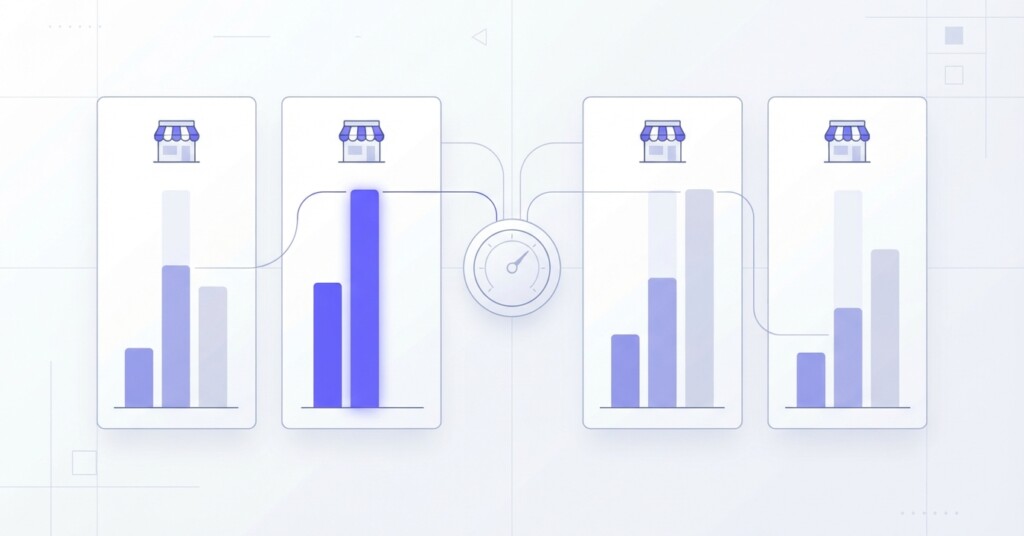
Running a multi-channel e-commerce business sounds like a growth strategy. In practice, it often becomes a resource problem. You are splitting your team, your marketing budget and your operations across Shopify, Shopee, Lazada, TikTok Shop and possibly more — and none of them are getting the focused attention they need to reach their potential. Revenue is spread thin, margins are eroding on some channels, and you are not sure which ones are actually worth the effort.
The question is not which channels are popular. The question is which channels are profitable for your specific business, with your specific cost structure — and which ones deserve more of your capital and attention right now. This article walks you through a structured framework for making that decision using real financial data rather than intuition.
Why Multi-Channel Expansion Creates a Profitability Problem
Every sales channel carries its own fee structure, fulfilment requirements, advertising mechanics and customer acquisition costs. When you add a new channel, you do not simply multiply your revenue — you multiply your operational complexity and your cost base.
Consider a business selling skincare products across four channels. Shopify gives them direct-to-consumer control but requires paid traffic. Shopee offers organic reach but takes a commission on every sale. Lazada runs frequent campaigns that drive volume but compress margins. TikTok Shop delivers burst revenue through live commerce but demands constant content production. Each channel has a completely different cost profile, and treating them equally in your planning is a mistake.
The core issue with multi-channel businesses is not that channels are unprofitable — it is that operators rarely measure each channel on the same financial basis. Without a consistent view of contribution margin by channel, every prioritisation decision is guesswork.
The Metric That Actually Matters: Contribution Margin by Channel
Gross margin tells you how much revenue remains after the cost of goods. But for channel prioritisation, you need contribution margin — which strips out all the variable costs directly attributable to that channel before you allocate any shared overhead.
The contribution margin formula for a sales channel is:
| Channel Revenue | 100% |
| Less: Cost of Goods Sold | – COGS |
| Less: Platform Commission or Fees | – Platform % |
| Less: Channel-Specific Ad Spend | – Paid Traffic |
| Less: Fulfilment & Shipping (channel-specific) | – Logistics |
| Less: Returns & Refunds (channel rate) | – Returns |
| = Channel Contribution Margin | Result |
This figure — expressed as both a dollar amount and a percentage — is what tells you whether a channel is genuinely producing value, or simply producing revenue that costs more to generate than it is worth.

Building a Channel Comparison Table
To prioritise channels with confidence, you need to put all of them on a single comparative table. Below is an illustrative example based on a hypothetical mid-sized e-commerce business generating roughly $200,000 per month in total revenue across four channels.
| Metric | Shopify | Shopee | Lazada | TikTok Shop |
|---|---|---|---|---|
| Monthly Revenue | $80,000 | $55,000 | $40,000 | $25,000 |
| COGS (45%) | $36,000 | $24,750 | $18,000 | $11,250 |
| Platform Fees / Commission | $1,600 | $6,050 | $5,200 | $3,750 |
| Ad Spend | $12,000 | $4,400 | $3,200 | $5,000 |
| Fulfilment & Shipping | $6,400 | $5,500 | $4,800 | $2,500 |
| Returns & Refunds | $1,200 | $2,750 | $2,400 | $1,250 |
| Total Variable Costs | $57,200 | $43,450 | $33,600 | $23,750 |
| Contribution Margin ($) | $22,800 | $11,550 | $6,400 | $1,250 |
| Contribution Margin (%) | 28.5% | 21.0% | 16.0% | 5.0% |
The revenue rankings would suggest Shopify leads, followed by Shopee, then Lazada, then TikTok Shop. The contribution margin rankings confirm the same order — but the gap is much larger than revenue alone would suggest. TikTok Shop is generating $25,000 in revenue but only $1,250 in contribution margin. That is a 5% contribution margin on a channel that likely requires significant creator or content investment on top of ad spend.
A channel that produces strong revenue but a thin or negative contribution margin is consuming resources that could generate far more profit if redeployed to your stronger channels. Revenue growth without contribution margin improvement is not a business win — it is a cash flow drain.
Four-Factor Prioritisation Framework
Contribution margin is your primary filter, but it should not be your only one. Some channels are low-margin today but have structural advantages that make them worth investing in. Others are high-margin on small volumes but cannot scale. Use these four factors together to score each channel.
- Current contribution margin: What is this channel actually producing in profit terms right now? This is your baseline reality check.
- Margin scalability: If you double your spend or volume on this channel, does margin hold, improve or deteriorate? Channels where CAC rises sharply as you scale are dangerous.
- Operational leverage: Does this channel require proportionally more staff, content, or management time as it grows? Low operational leverage reduces the benefit of scaling.
- Strategic fit: Does this channel serve the customer segment and product category where you have genuine competitive advantage? A channel may be low-margin simply because your product mix is wrong for it, not because the channel itself is flawed.
Score each of your channels on all four factors. The channels that score well on current margin and scalability deserve more capital. The channels that score poorly on margin but well on strategic fit may deserve a targeted experiment to fix specific cost drivers before you scale or exit.
When a Channel Looks Bad but Is Not the Problem
Before you deprioritise a channel, diagnose whether the low margin is a channel problem or a product mix problem. A business might find that its Lazada performance is weak overall, but when it looks at product-level data within Lazada, a handful of SKUs are actually delivering 30%+ contribution margins while the rest drag the average down.
In this case, the right decision is not to exit Lazada — it is to rationalise the product catalogue on Lazada to the SKUs that actually perform. Conversely, if all products are underperforming on a channel, the problem is more likely the channel economics (commission rates, ad costs, return rates) rather than the product selection.
Similarly, a TikTok Shop that appears unprofitable may be suffering from poor ROAS on live session ad boosts or affiliate commissions that were set too high during launch. These are fixable operational problems, not fundamental channel flaws. The key is separating structural channel issues from execution issues before you make a capital allocation decision.
How to Reallocate Resources After You Have Ranked Your Channels
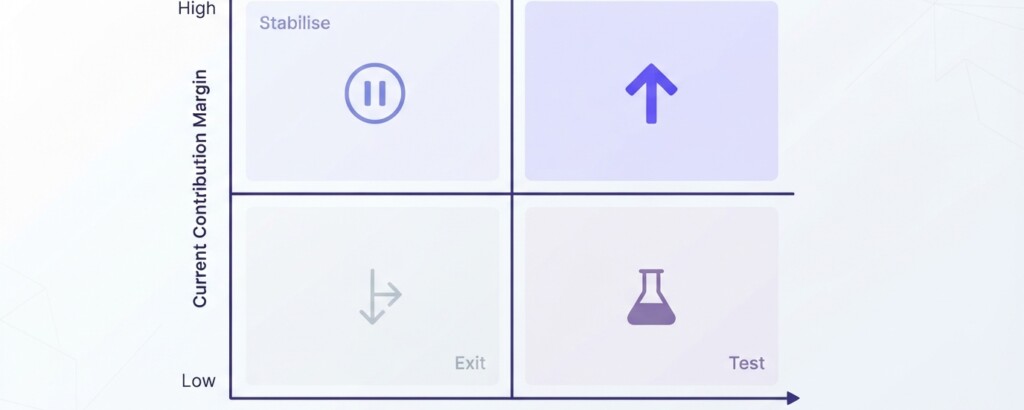
Once you have a clear contribution margin ranking and have applied the four-factor framework, you need an explicit reallocation plan. This means deciding not just where to put more resource, but where to actively pull resource from.
- Prioritise channels: Increase ad budget, improve listing quality, negotiate better logistics rates and assign dedicated team capacity to your top one or two channels by contribution margin and scalability.
- Stabilise mid-tier channels: Keep these running but set a contribution margin floor. If margin drops below a defined threshold, pause ad spend rather than scaling further.
- Run a 60-day fix-or-exit test on weak channels: Define two or three specific interventions (reduce SKU count, renegotiate fulfilment, adjust ad targeting) and set a measurable margin target. If the channel does not hit the target after 60 days, exit or reduce to minimal maintenance mode.
- Protect your direct channel: If you operate a Shopify store, this is typically your highest-margin channel because you control pricing, own the customer data, and pay no marketplace commission. Ensure it receives ongoing investment even while you optimise other channels.
Practical Example: Redirecting Budget from TikTok Shop to Shopify
Using the illustrative figures from the comparison table above, imagine reallocating $3,000 of the $5,000 monthly TikTok Shop ad spend to Shopify paid traffic. If Shopify’s blended ROAS is 3.5x, that additional $3,000 in spend generates approximately $10,500 in new revenue. At a 28.5% contribution margin, that produces roughly $2,993 in additional contribution profit.
By contrast, the same $3,000 spent on TikTok Shop at its baseline 5.0x ROAS generates $15,000 in revenue, which at a 5% contribution margin produces only $750 in contribution profit — assuming the ROAS even holds at scale, which it often does not on live-commerce-dependent channels.
This is a simplified illustration, but it makes the logic concrete. When you shift a dollar of spend from a 5% margin channel to a 28.5% margin channel, you are not just improving margins — you are fundamentally changing your monthly profitability.
Getting the Data Right
The biggest obstacle most multi-channel operators face is not making the wrong prioritisation decision — it is not having the data to make any decision with confidence. Platform dashboards report revenue in their own formats, use different attribution models, and do not account for your actual COGS or fulfilment costs.
Building a unified channel profitability view requires pulling revenue data from each platform, applying your actual COGS by SKU, and adding channel-specific costs (commissions, ad spend, returns, fulfilment differentials) in a consistent format. Many businesses do this in spreadsheets initially, which works but becomes difficult to maintain as product catalogues grow.
Tools like BrizoMarket are built to consolidate multi-channel sales data — including Shopify, Shopee, Lazada and TikTok Shop — with your cost inputs, so you can see contribution margin by channel and by product without rebuilding the analysis from scratch each month. If you are making channel prioritisation decisions without a consolidated margin view, you are working with incomplete information.
Key Takeaways and Next Steps
Channel prioritisation is fundamentally a capital allocation decision. Every dollar you spend on a weak channel is a dollar you are not deploying on a stronger one. The businesses that grow profitably across multiple channels are not the ones that are present everywhere — they are the ones that know exactly which channels produce the best return and concentrate their resources accordingly.
- Calculate contribution margin for each channel this month, using actual COGS, platform fees, ad spend, fulfilment and return costs.
- Build a channel comparison table and rank channels by contribution margin percentage, not by revenue.
- Apply the four-factor framework (current margin, margin scalability, operational leverage, strategic fit) to each channel.
- Set explicit decisions for each channel: scale, stabilise, test-to-fix, or exit.
- Review the product mix within underperforming channels before exiting — the problem may be SKU selection, not the channel itself.
- Establish a monthly review cadence so that channel prioritisation decisions are data-driven and updated as costs and performance shift.
Get a Clear View of Profitability Across Every Channel
If you are running across Shopify, Shopee, Lazada, TikTok Shop or other platforms and cannot see your contribution margin by channel in one place, BrizoMarket can help you build that view — so your next prioritisation decision is based on real numbers.