How to Calculate the Break-Even Sell-Through Rate for a Promotion Before You Discount a Single SKU
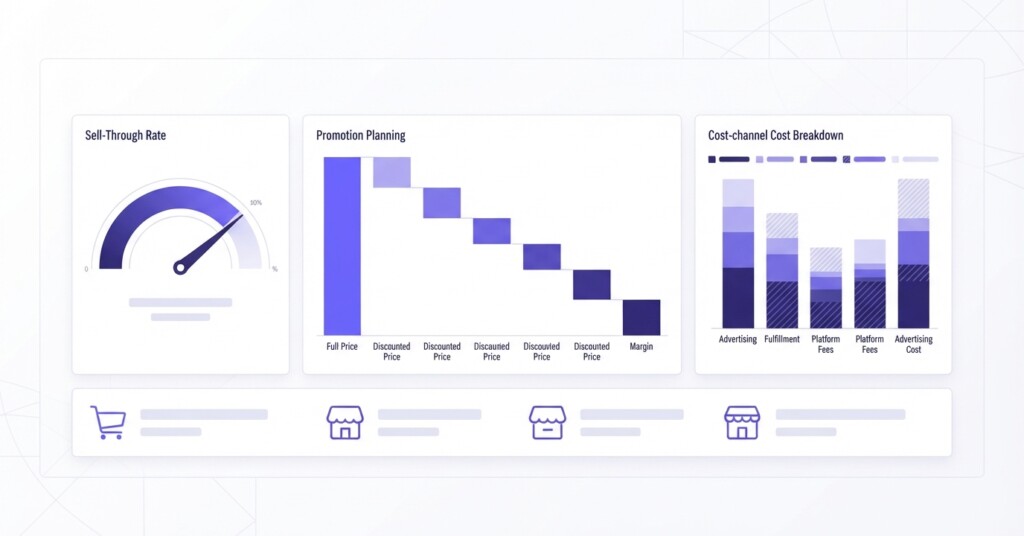
Running a promotion without knowing your break-even sell-through rate is one of the most expensive mistakes in e-commerce. You mark down a SKU, drive traffic across Shopify, Shopee, Lazada and TikTok Shop, and at the end of the campaign you have less inventory and less cash — but no clear picture of whether the promotion actually paid for itself. The break-even sell-through rate (BESTR) tells you exactly what percentage of available inventory you need to sell at the discounted price before the promotion becomes profitable. Calculate it before you discount, and you turn guesswork into a go or no-go decision backed by your own numbers.
Why Standard Margin Thinking Fails During Promotions
Most operators check gross margin before a promotion and assume that as long as the discounted price stays above cost, they are fine. That logic ignores three realities of running a promotion: incremental sales volume, the fixed and variable costs tied to the campaign itself, and the opportunity cost of the inventory you are liquidating. A product with a 40% gross margin at full price can easily generate a net loss when you apply a 25% discount, fund paid media to push it, and absorb platform fees across multiple channels.
The break-even sell-through rate reframes the question. Instead of asking ‘is the discounted price still above cost?’, you ask ‘how much of my available stock do I need to sell at this price to recover every cost the promotion creates?’ That is a much more useful question — and it has a precise numerical answer.
The Core Formula
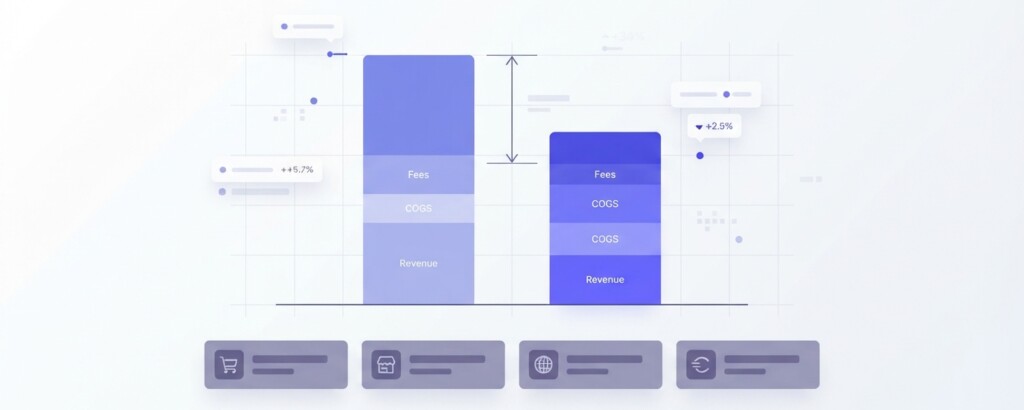
The break-even sell-through rate is expressed as a percentage of available stock. The formula has two components: the contribution margin per unit at the discounted price, and the total incremental costs created by the promotion.
Break-Even Sell-Through Rate = (Total Promotion Costs) ÷ (Contribution Margin per Unit at Discounted Price × Available Stock Units) × 100
Contribution margin per unit at the discounted price is the discounted selling price minus variable costs: cost of goods, platform commission, payment processing fee, fulfilment cost, and any per-unit advertising spend. Total promotion costs are the fixed overheads created specifically by running this campaign — paid media budget, creative production, platform campaign fees, and any additional labour. Once you have both figures, the formula tells you the minimum percentage of stock you must sell to break even on the promotion.
A Realistic Worked Example
Consider a skincare brand selling a moisturiser at a full price of $38 on Shopify and Lazada. The SKU has 800 units in stock. The team wants to run a 20% promotional discount — bringing the price to $30.40 — across both channels simultaneously, backed by $1,200 in Meta ads and a $300 Lazada campaign placement fee.
| Cost Component | Full Price ($38) | Discounted Price ($30.40) |
|---|---|---|
| Selling Price | $38.00 | $30.40 |
| Cost of Goods (COGS) | $9.50 | $9.50 |
| Platform Commission (avg 8%) | $3.04 | $2.43 |
| Payment Processing (2%) | $0.76 | $0.61 |
| Fulfilment & Shipping | $3.20 | $3.20 |
| Total Variable Cost per Unit | $16.50 | $15.74 |
| Contribution Margin per Unit | $21.50 | $14.66 |
The discount compresses contribution margin per unit from $21.50 to $14.66 — a reduction of $6.84 per unit, or nearly 32%. That compression is where promotions quietly destroy profitability. Now calculate the total fixed promotion costs.
| Meta Ads Budget (Facebook & Instagram) | $1,200.00 |
| Lazada Campaign Placement Fee | $300.00 |
| Creative Production (photography & copy) | $250.00 |
| Total Promotion Fixed Costs | $1,750.00 |
Apply the break-even sell-through rate formula: $1,750 ÷ ($14.66 × 800) = $1,750 ÷ $11,728 = 0.149, or approximately 14.9%. That means the brand needs to sell at least 120 of its 800 units (14.9%) at $30.40 before the promotion breaks even on its own costs. Every unit sold beyond that point generates incremental contribution. Selling fewer than 120 units means the promotion costs more than it returns — even before considering the margin sacrificed on units that would have sold at full price.
Adjusting for Multi-Channel Complexity
When a promotion runs across Shopify, Shopee, Lazada and TikTok Shop simultaneously, the calculation becomes more nuanced because platform fees, fulfilment costs and average selling prices differ by channel. A flat BESTR calculation using averaged inputs will give you a misleading number. Instead, build a channel-level version of the same analysis.
| Channel | Discounted Price | Platform Commission | Fulfilment | Contribution Margin/Unit | Allocated Stock | Break-Even Units |
|---|---|---|---|---|---|---|
| Shopify | $30.40 | 2% (payment only) | $3.20 | $17.09 | 300 units | 33 units (11%) |
| Lazada | $30.40 | 8% | $3.20 | $14.66 | 250 units | 48 units (19%) |
| Shopee | $30.40 | 6% | $2.80 | $15.37 | 150 units | 38 units (25%) |
| TikTok Shop | $30.40 | 5% + creator fees | $3.20 | $13.94 | 100 units | 35 units (35%) |
This channel-level view reveals that TikTok Shop — where commission plus creator fees compress margin to $13.94 per unit — requires you to sell 35% of allocated stock just to break even on that channel’s share of campaign costs. If your historical TikTok Shop sell-through on a comparable SKU is 20%, the channel allocation does not make financial sense at this discount level. You can either reduce the TikTok Shop allocation, remove the creator fee arrangement, or increase the selling price on that channel.
TikTok Shop affiliate and creator commission is often treated as a marketing cost rather than a platform cost, which causes operators to underestimate true variable cost per unit. Always include creator fees in your per-unit variable cost calculation before running the break-even analysis.
The Hidden Cost: Full-Price Cannibalisation
The standard break-even sell-through rate calculation tells you when the promotion covers its own costs. It does not tell you the full opportunity cost if discounted units replace units that would have sold at full price anyway. This is the cannibalisation risk, and it matters most for evergreen SKUs with consistent organic demand.
If your moisturiser normally sells 80 units per month at $38 across all channels, and your promotion sells 200 units in two weeks at $30.40, the incremental volume is not 200 — it is closer to 160. The remaining 40 units would likely have sold at full price. The lost contribution on those 40 units is 40 × $6.84 = $273.60. Add that to your promotion fixed costs before running the break-even calculation, and your effective total cost becomes $2,023.60, raising the break-even sell-through rate to 17.3% rather than 14.9%.
For slow-moving or seasonal SKUs where organic sell-through is minimal, cannibalisation is less of a concern. For high-velocity core products, it should always be factored in.
Step-by-Step: Running the Break-Even Analysis Before a Promotion
- Pull the current selling price, COGS, platform commission rate, payment processing rate and fulfilment cost for the SKU on each channel.
- Apply the proposed discount to calculate the discounted selling price per channel.
- Recalculate contribution margin per unit at the discounted price for each channel, including all variable costs.
- List every fixed cost created specifically by the promotion: paid media budget, platform placement fees, creative costs, any influencer or creator fees.
- Allocate fixed promotion costs to each channel proportionally, based on planned stock allocation or expected revenue split.
- Calculate the break-even sell-through rate per channel: channel fixed costs ÷ (contribution margin per unit × allocated stock units).
- Compare each channel’s break-even sell-through rate against its historical sell-through rate for comparable promotions.
- Adjust stock allocation, discount depth or channel mix until each channel’s break-even rate is achievable based on historical performance.
- Estimate the cannibalisation volume for evergreen SKUs and add the lost contribution to your total promotion cost before finalising the analysis.
- Set a minimum viable sell-through threshold for the overall campaign. If you cannot confidently forecast reaching it, reconsider the promotion structure.
Using the Analysis to Make Better Promotion Decisions
The break-even sell-through rate is not just a go or no-go filter. It is a sensitivity tool. Once you have the baseline figure, you can run scenarios: what happens to the break-even rate if you reduce the discount from 20% to 15%? What if you cut paid media spend by $400? What if you limit the promotion to Shopify and Lazada, and exclude TikTok Shop where margin compression is highest?
For example, reducing the discount from 20% to 15% on the moisturiser example raises the discounted price from $30.40 to $32.30. After accounting for platform commission and payment processing on the higher price, contribution margin per unit on Lazada rises from $14.66 to $16.37. The break-even sell-through rate for Lazada drops from 19% to around 17%. A smaller discount often generates a lower break-even rate while still driving promotional traffic — particularly on platforms like Shopee where platform-level vouchers and bundle mechanics can supplement a shallower headline discount.
The most profitable promotions are not necessarily the deepest discounts. A 10–15% discount with a low break-even sell-through rate and strong incremental volume often outperforms a 30% discount that cannibalises full-price sales and requires high media spend to generate volume.
Tracking Actuals Against Your Break-Even Target
Calculate the break-even sell-through rate before the promotion, then track actual sell-through daily against that target during the campaign. If you reach the break-even threshold within the first 48 hours on a channel, you have headroom — you can choose to extend, increase stock allocation, or let the remaining inventory generate pure incremental contribution. If you are at day four of a seven-day campaign and you have only reached 60% of your break-even threshold, you need to intervene: increase media spend, activate an additional voucher, or accept that the channel is underperforming and pull inventory back.
Operators using BrizoMarket can surface sell-through rate data across channels in a single view, making it straightforward to compare actual promotion performance against the pre-calculated break-even threshold without manually reconciling reports from Shopify, Lazada, Shopee and TikTok Shop separately.
Key Takeaway
Every promotion is a financial decision, not a marketing instinct. Before you apply a discount to a single SKU, calculate the break-even sell-through rate using your actual cost structure, your actual channel fees, and a realistic estimate of incremental versus cannibalised volume. The number will often surprise you — and it will tell you whether the promotion structure, discount depth and channel mix you are planning can actually generate a positive return. Run the numbers first. Adjust the promotion design until the break-even rate is achievable. Then launch.
Track Sell-Through Rate Across Every Channel in One Place
BrizoMarket helps e-commerce operators monitor promotion performance, contribution margin and sell-through rate across Shopify, Lazada, Shopee and TikTok Shop — so you can measure actual results against your break-even targets in real time.