How to Reconcile Revenue and Fees Across Multiple Sales Channels Into One P&L

If you sell across Shopify, Shopee, Lazada and TikTok Shop simultaneously, you already know the pain: every platform pays you differently, deducts fees differently, and reports revenue in its own format. By the time you pull all those numbers together at month end, you are not looking at one business — you are looking at four separate financial realities that need to be stitched into a single picture.
This article walks through a practical framework for reconciling revenue and fees from multiple sales channels into one consolidated P&L. The goal is not just tidier spreadsheets — it is understanding which channels are actually profitable, which are quietly eroding your margins, and where your next dollar of effort should go.
Why Multi-Channel Revenue Is Harder to Reconcile Than It Looks
The core problem is that each platform mixes revenue recognition, fee deductions and settlement timing in its own way. Shopify reports gross order value and charges transaction fees separately through your payment processor. Shopee deducts commission, transaction fees and shipping subsidies before settling to your bank account. Lazada bundles several fee types into a single deduction visible only inside Seller Centre reports. TikTok Shop has its own commission structure, affiliate fees and short-term promotional subsidies layered on top.
The result is that your bank account receives settlement amounts that bear no obvious relationship to your gross sales figures — and if you build your P&L from bank deposits alone, you are dramatically understating both revenue and costs.
Always build your P&L from gross order value down, not from bank settlement amounts up. Platforms deduct fees before paying you, which means your bank deposits represent net settlement payouts — not net revenue. Skipping the gross-to-net bridge causes you to understate both revenue and costs at the same time.
Step One: Standardise What ‘Revenue’ Means Across Every Channel
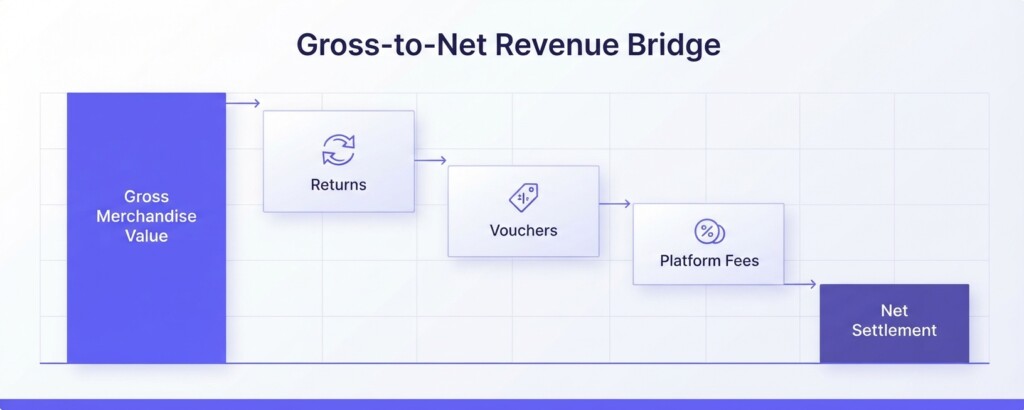
Before you can reconcile anything, you need a consistent definition of revenue that works across all platforms. The most reliable starting point is Gross Merchandise Value (GMV) — the total value of orders placed, before any cancellations, returns, platform fees or discounts. From GMV, you work down to Net Revenue by deducting customer-initiated returns, cancellations, and seller-funded vouchers, before separately accounting for platform fees and fulfilment deductions to reconcile to your net settlement payout.
A practical example: suppose your Shopee store records 500,000 in GMV for the month. After 3% in customer-initiated returns (15,000) and 12,000 in seller-funded vouchers, your net revenue is 473,000. Shopee then deducts a 5.5% commission (26,015), a 2% transaction fee (9,460), and a logistics rebate clawback of 2,000, leaving you with a platform settlement of approximately 435,525. Your P&L should show 500,000 as GMV, 473,000 as net revenue, and record the 37,475 in platform deductions as cost of revenue and operating expenses — reconciling down to the 435,525 settlement that arrives in your bank.
Step Two: Map Every Fee Type to a P&L Line
Each platform charges fees that map to different cost categories in your P&L. Getting this mapping right is what separates a useful consolidated P&L from a misleading one. Here is how the most common fee types should be categorised:
| Fee Type | Platform Examples | P&L Category |
|---|---|---|
| Commission / Referral Fee | Shopee 5.5%, Lazada 3–8%, TikTok Shop 3–8% | Cost of Revenue |
| Payment / Transaction Fee | Shopify Payments 1.5–2.9%, Shopee 2%, Lazada 2% | Cost of Revenue |
| Affiliate / Creator Commission | TikTok Shop affiliate payouts | Marketing Expense |
| Seller-Funded Vouchers / Discounts | All platforms | Contra-Revenue or Marketing |
| Shipping Subsidies Clawback | Shopee, Lazada | Fulfilment Cost |
| Warehouse / Fulfilment Fees | Lazada LEX, Shopee SLS | Fulfilment Cost |
| Advertising Spend (CPC/CPM) | Shopee Ads, Lazada Sponsored, TikTok Ads | Marketing Expense |
| Returns Handling Fees | Various platforms | Fulfilment Cost |
One common mistake is lumping all platform deductions into a single ‘platform fees’ line. This hides important distinctions: a commission is a variable cost tied directly to revenue, while an affiliate payout is a marketing cost, and a fulfilment fee is an operational cost. Separating them correctly lets you calculate an accurate gross profit and contribution margin for each channel.
Step Three: Build the Channel-Level P&L Template
Once your fee mapping is in place, you can build a consistent P&L template for each channel and then consolidate them. Here is what that structure looks like for a single channel:
| Gross Merchandise Value (GMV) | 500,000 |
| Less: Returns & Cancellations | (15,000) |
| Less: Seller-Funded Vouchers | (12,000) |
| = Net Revenue | 473,000 |
| Less: Platform Commission | (26,015) |
| Less: Payment / Transaction Fees | (9,460) |
| Less: Shipping Subsidy Clawback | (2,000) |
| = Net Platform Settlement | 435,525 |
| Less: Cost of Goods Sold (COGS) | (195,000) |
| = Gross Profit | 240,525 |
| Less: Fulfilment & Warehousing | (35,000) |
| Less: Channel Advertising Spend | (42,000) |
| Less: Affiliate / Creator Fees | (18,000) |
| = Channel Contribution Margin | 145,525 |
Contribution margin is the number that matters most at the channel level. It tells you how much each channel contributes to covering your shared overheads — logistics infrastructure, team salaries, software subscriptions, and so on — before you assign any shared costs. A channel with high GMV but low or negative contribution margin is consuming resources without producing a return.
Step Four: Consolidate Into a Single Multi-Channel P&L
With a consistent template applied to each channel, consolidation becomes straightforward. The table below shows what a monthly consolidated view might look like across four channels for a mid-sized ecommerce business:
| Metric | Shopify | Shopee | Lazada | TikTok Shop | Total |
|---|---|---|---|---|---|
| GMV | 320,000 | 500,000 | 180,000 | 210,000 | 1,210,000 |
| Net Revenue (after fees) | 298,000 | 435,525 | 152,400 | 178,500 | 1,064,425 |
| COGS | (130,000) | (195,000) | (68,000) | (92,000) | (485,000) |
| Gross Profit | 168,000 | 240,525 | 84,400 | 86,500 | 579,425 |
| Gross Margin % | 52.5% | 48.1% | 46.9% | 41.2% | 47.9% |
| Fulfilment & Ads | (65,000) | (95,000) | (52,000) | (78,000) | (290,000) |
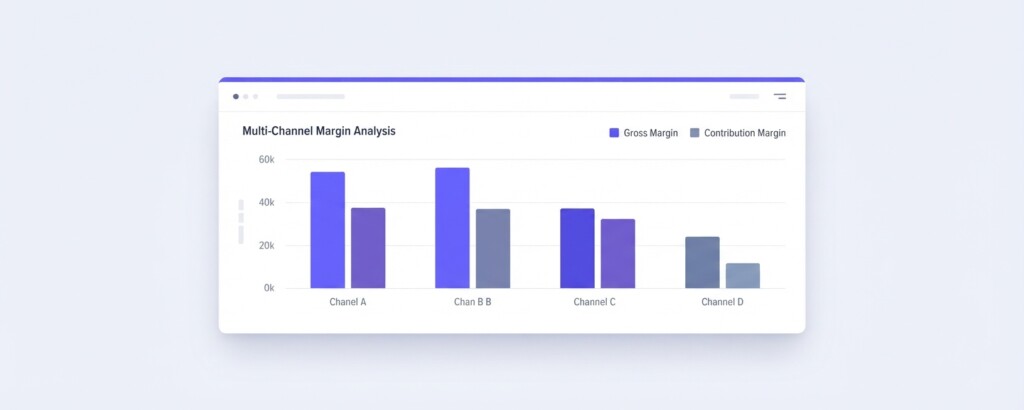
| Contribution Margin | 103,000 | 145,525 | 32,400 | 8,500 | 289,425 |
| Contribution Margin % | 32.2% | 29.1% | 18.0% | 4.0% | 23.9% |
This view reveals something a simple sales report would never show: TikTok Shop is generating 210,000 in GMV but contributing only 8,500 to the business after all channel-specific costs. That 4% contribution margin suggests the channel is either over-spending on ads and affiliate creators, suffering from high returns, or both. Without this consolidated view, TikTok Shop looks like a growing revenue line — when in practice it is close to breakeven.
Do not use platform dashboard revenue figures directly in your P&L without cross-checking against settlement statements. Dashboard figures often include pending orders, unconfirmed returns, or promotional credits that will not settle as cash. Always reconcile from the official financial settlement report, not the analytics overview.
Step Five: Handle Timing Differences in Settlements
Settlement timing is one of the most overlooked issues in multi-channel reconciliation. Shopify settlements typically arrive within two to three business days. Shopee and Lazada operate on weekly or bi-weekly settlement cycles with holding periods for return windows. TikTok Shop holds funds for a defined period after delivery confirmation.
This means that revenue earned in Month A may settle in your bank account in Month B. If your P&L is cash-based rather than accrual-based, your monthly figures will always be distorted. The fix is to record revenue in the period when the order is confirmed and fulfilled — and track outstanding settlement balances as accounts receivable from each platform.
- Download the official settlement statement from each platform at month end, not just the analytics export.
- Match each settlement payment to the orders it covers using the settlement ID or order date range.
- Record any unsettled confirmed orders as accounts receivable in your balance sheet.
- Track the holding period for each platform and flag any anomalous delays that could indicate a dispute or hold.
- Reconcile your bank statement against expected settlements weekly, not monthly.
Step Six: Allocate Shared Costs to Complete the Business P&L
Contribution margin is a channel-level metric. To build a complete business P&L, you need to allocate shared costs — the expenses that support all channels but cannot be directly attributed to one. These include warehousing infrastructure, customer service team salaries, software tools, and management overhead.
A practical allocation method is to distribute shared costs in proportion to each channel’s share of net revenue. If Shopify represents 28% of total net revenue, assign 28% of shared overhead to Shopify. This is imperfect but gives you a channel-level EBITDA view that is far more useful than no allocation at all. Review the allocation method quarterly, since channel revenue mixes shift over time.
Using Analytics Tools to Automate the Reconciliation
Manual reconciliation across four platforms using separate spreadsheets is feasible when you are small, but it becomes error-prone and time-consuming as order volumes grow. The practical solution is a reporting layer that pulls data directly from each platform’s API and standardises it into a consistent P&L structure automatically.
Dedicated ecommerce analytics and reconciliation platforms are built specifically for this use case — connecting to Shopify, Shopee, Lazada, TikTok Shop and other channels to consolidate revenue, fees, COGS and advertising spend into a single multi-channel P&L view. Rather than spending hours each month downloading statements and mapping fees in Excel, finance managers can see a consistent, reconciled view of gross profit and contribution margin by channel in real time. This is particularly useful when trying to answer questions like ‘is our Lazada investment actually profitable?’ without waiting for month-end.
Key Metrics to Track Once Your P&L Is Reconciled
A properly reconciled multi-channel P&L unlocks a set of metrics that are genuinely actionable for ecommerce operators:
- Effective fee rate per channel: total platform fees as a percentage of GMV. Anything above 15% combined warrants a pricing or channel strategy review.
- Return rate by channel: high return rates on specific channels often indicate product listing or expectation management issues.
- ROAS by channel: ad spend versus the gross profit it generates, not just revenue.
- Contribution margin by channel: the clearest single indicator of channel profitability after all direct costs.
- Voucher subsidy ratio: seller-funded discounts as a percentage of GMV, which directly compresses your net revenue without always being visible in headline sales figures.
Practical Next Steps
Start with last month. Pull the official settlement statement — not the analytics dashboard — from each platform you sell on. Map every fee line to a P&L category using the framework above. Build the gross-to-net revenue bridge for each channel. Then consolidate into a single view and calculate contribution margin per channel. What you find will almost certainly shift your thinking about where to invest and where to pull back.
The businesses that consistently grow profitable multi-channel operations are not the ones selling on the most platforms — they are the ones that understand, with precision, what each platform actually costs them and what it actually returns. Reconciliation is not a finance exercise. It is a strategic one.
Stop Guessing Which Channels Are Actually Profitable
Consolidating your Shopify, Shopee, Lazada and TikTok Shop data into one P&L lets you see gross profit, contribution margin and channel performance without the manual reconciliation work.