How to Calculate the True Cost of Seller-Funded Vouchers Across Shopee, Lazada, and TikTok Shop

Seller-funded vouchers are one of the most commonly misunderstood cost items in multi-channel e-commerce. On Shopee, Lazada, and TikTok Shop, these discounts appear straightforward — you offer a voucher, buyers use it, and you see a reduced settlement amount. But the real question is whether those vouchers are actually growing your business or simply subsidising purchases that would have happened anyway at full price.
This article walks through how to calculate the true cost of seller-funded vouchers, what incremental margin means in practice, and how to build a simple framework to judge whether your voucher activity is generating profit or destroying it.
What Are Seller-Funded Vouchers and How Do They Work?
On Shopee, Lazada, and TikTok Shop, vouchers fall into two broad categories: platform-funded and seller-funded. Platform-funded vouchers are subsidised by the marketplace itself, often during major campaigns like 11.11 or Shopee Payday. Seller-funded vouchers are discounts that come directly out of your settlement — your margin absorbs the cost entirely.
Seller-funded vouchers typically take the form of shop vouchers (a fixed dollar or percentage discount applied at checkout), product-level vouchers, bundle deals, or free shipping vouchers where you absorb the shipping subsidy. The mechanics differ slightly between platforms, but the financial impact is the same: the voucher reduces the amount you receive per order, without reducing your fulfilment costs or cost of goods.
Why the Headline Discount Is Not the True Cost
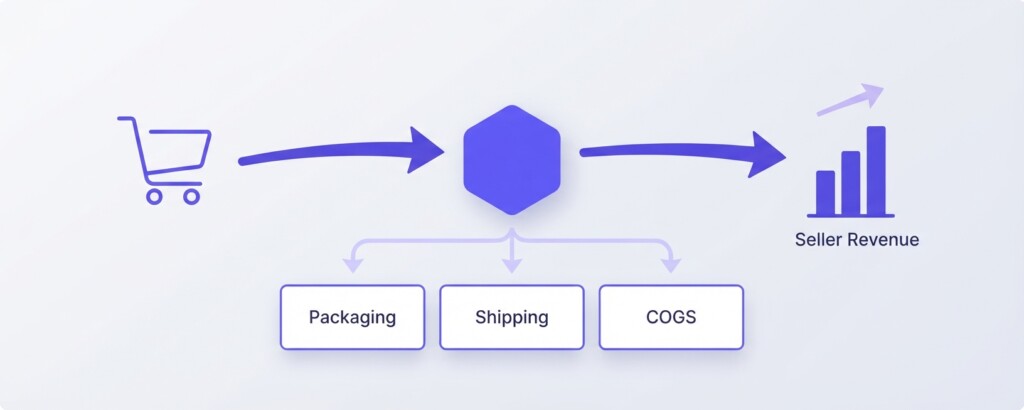
If you offer a $5 voucher on a $50 order, most sellers record this simply as a $5 cost. However, evaluating the true cost requires understanding how marketplace fee structures interact with promotions. Unlike platform-funded vouchers, where commission is calculated on the pre-discount value because the marketplace reimburses the difference, seller-funded vouchers reduce the base price on which platform commissions and transaction fees are assessed across Shopee, Lazada, and TikTok Shop. While this provides modest savings on percentage-based fees, fixed expenses such as packaging, shipping subsidies, and product costs remain completely unchanged.
Beyond commissions, you also need to factor in payment processing fees, the cost of goods sold (COGS), and any fulfilment costs. Once all of these are layered in, a $5 voucher on a $50 item with thin margins can flip an order from marginally profitable to deeply unprofitable.
Always calculate voucher cost as a percentage of your net contribution margin, not as a percentage of GMV. A 10% voucher on a product with 20% contribution margin wipes out half your profit before a single other cost is considered.
Building the True Cost Calculation
Here is a worked example using a typical SKU sold across Shopee and Lazada. The product is a skincare serum with a retail price of $45. The seller offers a $6 shop voucher during a weekend flash sale.
| Retail selling price | $45.00 |
| Less: Seller-funded voucher | -$6.00 |
| Net selling price (buyer pays) | $39.00 |
| Less: Platform commission (8% on net price of $39) | -$3.12 |
| Less: Payment processing fee (2% on $39) | -$0.78 |
| Less: Shipping subsidy (seller-absorbed) | -$2.50 |
| Net revenue received | $32.60 |
| Less: Cost of goods sold | -$18.00 |
| Less: Packaging and fulfilment | -$2.00 |
| Contribution margin per order | $12.60 |
Without the voucher, the same order generates a contribution margin of $18.00 ($45.00 retail price minus $3.60 commission, $0.90 payment fee, $2.50 shipping subsidy, $18.00 COGS, and $2.00 packaging). With the voucher, your margin drops to $12.60 — a net difference of $5.40 rather than the headline $6.00, because the lower net price slightly reduces percentage-based platform commission (saving $0.48) and payment fees (saving $0.12). However, while the dollar deduction is slightly buffered by fee savings, the margin impact is severe: a 13.3% discount on retail price wipes out 30% of your contribution margin ($5.40 of $18.00). Small discounts compound into substantial margin compression across thousands of orders.
Comparing Voucher Economics Across Shopee, Lazada, and TikTok Shop
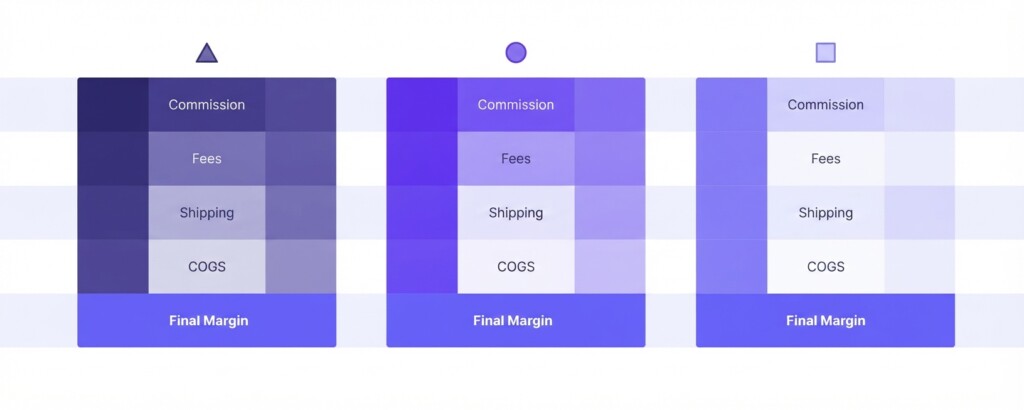
Each platform has slightly different mechanics that affect how voucher costs land in your P&L. The table below summarises the key differences to watch when modelling voucher profitability.
| Factor | Shopee | Lazada | TikTok Shop |
|---|---|---|---|
| Commission basis | Calculated post-seller voucher (item price less seller promotions) | Calculated post-seller voucher (item price less seller promotions) | Calculated post-seller voucher (item price less seller discounts) |
| Shipping subsidy absorption | Seller-funded where selected | Seller-funded where selected | Seller-funded; fulfilment fees may also apply |
| Voucher visibility to buyer | High — prominent at checkout | High — shown in cart | High — often surfaced in live and short video |
| Campaign voucher co-funding | Available during major events | Available during major events | Growing but platform-dependent |
| Settlement transparency | Itemised in seller centre | Itemised in seller centre | Improving; use transaction-level export for accuracy |
One important nuance on TikTok Shop: because purchases are often driven by short-video or live-stream content, vouchers interact with attribution differently. A buyer who discovers your product through a creator video and uses a voucher may represent a genuinely new customer — or they may be a repeat buyer who follows your brand account. Without order-level data segmented by buyer history, you cannot tell.
The Incrementality Problem: Are You Growing Revenue or Subsidising It?
The most important question about any voucher programme is not ‘how much did we spend?’ — it is ‘what would have happened without the voucher?’ This is the incrementality problem, and it is genuinely difficult to solve without structured testing.
There are three buyer segments that every voucher tends to reach, in varying proportions:
- New buyers who would not have purchased at full price — the voucher is incremental and potentially justified if the lifetime value of the customer exceeds the voucher cost
- Existing buyers who would have purchased anyway at full price — the voucher is a pure margin subsidy with no incremental benefit
- Price-sensitive buyers who only purchase with a voucher — recurring cost with uncertain lifetime value depending on their repeat behaviour without discounts
Without segmenting your voucher redemptions by buyer type, you are effectively averaging across all three groups and hiding the true economic picture. If 70% of your voucher redemptions go to repeat buyers who would have purchased anyway, your voucher programme is redistributing margin to your most loyal customers — not growing your business.
If your voucher redemption rate spikes during campaigns but your new buyer count stays flat, this is a strong signal that vouchers are primarily subsidising existing buyers rather than acquiring new ones. Check new-versus-returning buyer ratios in your seller centre analytics before and after each voucher campaign.
A Practical Framework for Evaluating Voucher ROI
Rather than running vouchers on instinct or matching competitor promotions, build a simple evaluation framework around three metrics: voucher cost as a percentage of contribution margin, new buyer ratio among redeemers, and 90-day repeat purchase rate of voucher-acquired buyers.
- Calculate contribution margin per SKU without the voucher as your baseline — this is your maximum affordable voucher depth
- Set a voucher floor: the minimum contribution margin you will accept per order after voucher, fees, and COGS (for example, 15% of net revenue)
- Tag voucher redemption orders in your data and cross-reference against buyer purchase history to identify new versus returning buyers
- Calculate the blended cost of the voucher programme: total voucher spend divided by the number of orders attributable to genuinely new buyers
- Compare that blended acquisition cost against your estimated 12-month customer lifetime value to determine whether the spend is justified
- For repeat buyers who redeem vouchers, assess whether their order frequency or basket size increases — if not, the voucher is pure subsidisation
Why Multi-Channel Sellers Face a More Complex Problem
If you sell across Shopee, Lazada, and TikTok Shop simultaneously, voucher analysis becomes more complicated because buyers may move across channels. A buyer who redeems a Lazada voucher this month may have been a Shopee buyer last month. Without a unified view of buyer behaviour across platforms, you will misclassify repeat buyers as new buyers and overestimate the incrementality of your voucher activity.
This is one area where tools that consolidate multi-channel order and customer data become genuinely useful rather than optional. BrizoMarket, for instance, is designed to pull together transaction-level data across Shopee, Lazada, and TikTok Shop so that sellers can analyse voucher cost and contribution margin at the order level across channels without manually reconciling multiple platform exports.
Even if you are not using a dedicated analytics platform, sellers often try to reconcile customer identities manually, though platform data protection rules make this increasingly difficult. Shopee, Lazada, and TikTok Shop strictly mask buyer personally identifiable information (PII) such as phone numbers and email addresses in standard order exports, meaning cross-channel buyer mapping generally requires integrated multi-channel systems, first-party CRM tools, or post-purchase customer registration.
What Good Voucher Economics Look Like
A well-structured voucher programme will show three characteristics. First, voucher depth is calibrated to SKU margin — higher-margin products can absorb deeper discounts without breaching your contribution floor. Second, a meaningful portion of redemptions (ideally 40% or more, depending on your category) come from first-time buyers who go on to make at least one subsequent purchase without a voucher. Third, your overall channel contribution margin is stable or improving even during heavy voucher periods, because volume gains offset individual order margin compression.
If none of these conditions are met, you are running a voucher programme that feels like marketing but functions like a margin erosion mechanism. The sales numbers may look healthy, but the underlying economics are deteriorating with each campaign.
Practical Next Steps
- Pull your last three months of seller-funded voucher data from each platform and calculate the true per-order contribution margin including commission, fees, COGS, and fulfilment
- Segment voucher redemptions into new buyers and returning buyers using your platform buyer data
- Calculate what percentage of your total voucher spend went to returning buyers who would likely have purchased anyway
- Set a formal contribution margin floor for each channel and each key SKU category — do not run vouchers that push any order below this floor
- Design a 30-day A/B test: run vouchers on a subset of your audience and measure conversion rate and basket size versus the control group
- Track 90-day repeat purchase rates specifically for buyers acquired through voucher campaigns to assess real customer lifetime value
The goal is not to eliminate seller-funded vouchers — they can be an effective acquisition tool in the right context. The goal is to know exactly what each voucher campaign costs at the contribution margin level and whether the buyers it attracts generate enough long-term value to justify the spend.
Voucher management is ultimately a margin management discipline. The sellers who run voucher programmes profitably are not the ones who discount the deepest — they are the ones who track the most precisely.
Analyse Your Voucher Costs Across Every Channel
BrizoMarket helps multi-channel e-commerce sellers consolidate order and margin data from Shopee, Lazada, TikTok Shop, and more — so you can see exactly what your voucher programmes are costing you and whether they are generating real growth.