How to Calculate the True Cost of Free Shipping Thresholds and Whether They Increase or Destroy Net Margin
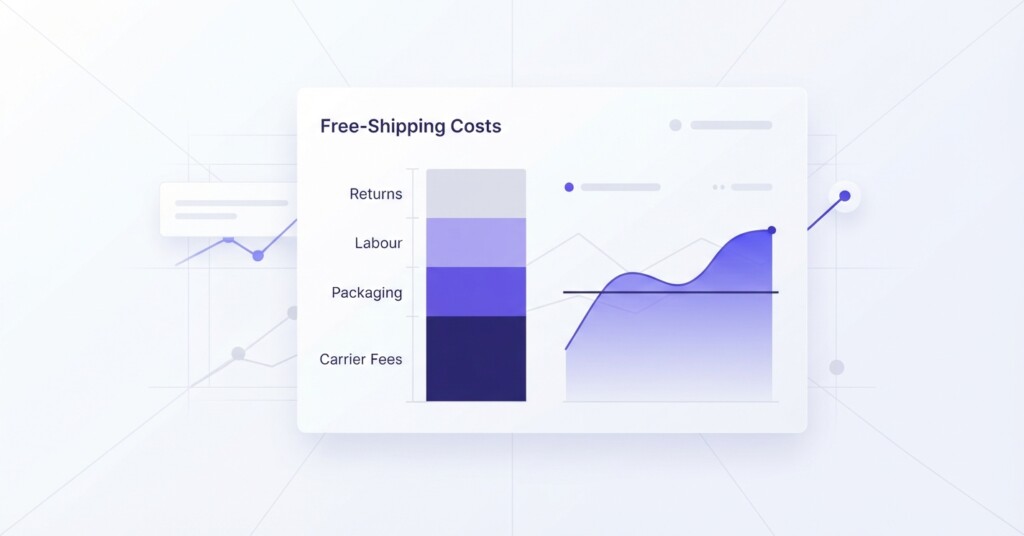
Free shipping is one of the most powerful conversion levers in e-commerce — and one of the most dangerous if you have not done the mathematics properly. Offering free shipping above a spend threshold feels like a clean marketing decision, but it carries real costs that sit across fulfilment, packaging, carrier contracts, and your contribution margin on every qualifying order. Before you set a threshold on Shopify, Shopee, Lazada or TikTok Shop, you need to know exactly what free shipping costs you, at what order value it starts paying for itself, and whether the lift in average order value (AOV) actually improves or erodes your net margin.
Why Free Shipping Thresholds Are Often Mispriced
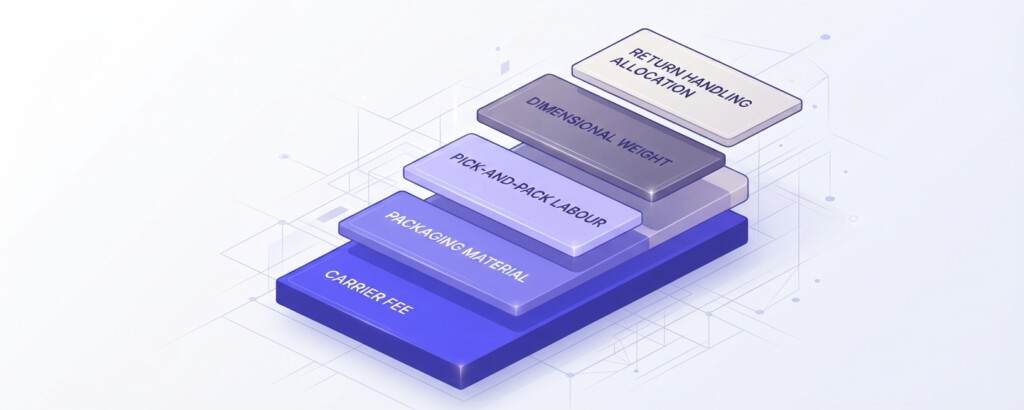
Most operators set a free shipping threshold by gut feel — rounding up from their current AOV and hoping customers spend a little more. The problem is that gut feel ignores several cost layers that compound against each other. Shipping is not just the carrier fee. It includes packaging materials, pick-and-pack labour, dimensional weight surcharges, and the handling cost for returns that free shipping tends to encourage. When you absorb all of those costs on an order that only marginally clears your threshold, the margin impact can be severe.
Equally important is the channel context. Shipping economics on Shopify — where you control fulfilment — are fundamentally different from Shopee or Lazada, where platform-subsidised shipping vouchers, seller-funded free shipping campaigns, and weight-based fee structures create a different cost equation entirely. TikTok Shop adds another layer, where impulse-driven low-AOV orders frequently qualify for free shipping promotions that were designed for a different basket size.
Building Your True Shipping Cost Per Order
Before you can evaluate whether your threshold is profitable, you need an accurate cost-per-shipped-order figure. This is not simply what your carrier charges. Work through each cost layer below for a realistic baseline.
| Carrier fee (zone-weighted average) | $6.20 |
| Packaging materials (box, void fill, tape) | $1.40 |
| Pick-and-pack labour (time × wage rate) | $1.80 |
| Dimensional weight surcharge (where applicable) | $0.60 |
| Return handling allocation (return rate × return cost) | $0.90 |
| True Cost Per Shipped Order | $10.90 |
In this example, the true shipping cost is $10.90 — not the $6.20 carrier fee that often appears on the P&L. Many businesses only see the carrier invoice and treat the rest as overhead, which means they systematically underestimate the cost of free shipping offers.
Run this calculation using your last 90 days of fulfilment data. Divide total fulfilment costs — including labour, packaging, and returns handling — by total orders shipped. If your result is more than 50% higher than your carrier rate alone, your threshold is almost certainly set too low.
The Break-Even Threshold Formula
Once you know your true shipping cost, you can calculate the minimum order value at which absorbing shipping still leaves you with acceptable contribution margin. The formula works from your gross margin percentage and your target contribution margin after shipping.
The core relationship is: the gross profit generated by an order must cover (a) the true shipping cost and (b) your minimum acceptable contribution margin in dollar terms. If your blended gross margin is 45% and your true shipping cost is $10.90, the shipping cost alone requires an order value of $10.90 ÷ 0.45 = $24.22 just to break even on shipping. Add your minimum contribution margin target — say $8.00 per order — and your threshold needs to be at least ($10.90 + $8.00) ÷ 0.45 = $42.00.
| Gross Margin % | True Shipping Cost | Min Contribution Target | Break-Even Threshold |
|---|---|---|---|
| 35% | $10.90 | $6.00 | $48.29 |
| 40% | $10.90 | $7.00 | $44.75 |
| 45% | $10.90 | $8.00 | $42.00 |
| 50% | $10.90 | $8.00 | $37.80 |
| 55% | $10.90 | $9.00 | $36.18 |
The table makes clear that lower-margin businesses need substantially higher thresholds to avoid destroying net margin. A business operating at 35% gross margin that sets a $39 free shipping threshold is likely giving away margin on almost every qualifying order.
Does the AOV Lift Actually Pay for Itself?
The standard justification for a free shipping threshold is that it lifts AOV — customers add items to qualify, so revenue per order increases. This is often true in aggregate. But the margin question is more nuanced: does the incremental revenue from the AOV lift generate enough incremental gross profit to cover the shipping cost you are now absorbing?
Consider a realistic scenario. Before the threshold, your AOV is $38 and you charge $6.50 for shipping. After introducing a $50 free shipping threshold, your AOV rises to $47. The customer spends $9 more on products — but you forfeit the $6.50 in shipping revenue previously collected. The net swing per qualifying order is: ($9.00 × 0.45 gross margin) − $6.50 lost shipping revenue = $4.05 gross profit gained − $6.50 revenue lost = a net loss of $2.45 per qualifying order where the customer previously paid for shipping.
If the gross profit from your AOV lift does not fully offset your lost shipping revenue and newly absorbed shipping costs, your free shipping promotion is contracting net margin even while appearing to grow revenue. Always model the full margin impact — not just the AOV movement.
The calculation gets more favourable when a meaningful portion of qualifying orders previously had AOVs well below the threshold — because those orders would not have converted at all without the free shipping incentive. In that case, the incremental revenue is genuinely additive. Segment your order history to understand which scenario applies to your business.
Channel-Specific Considerations
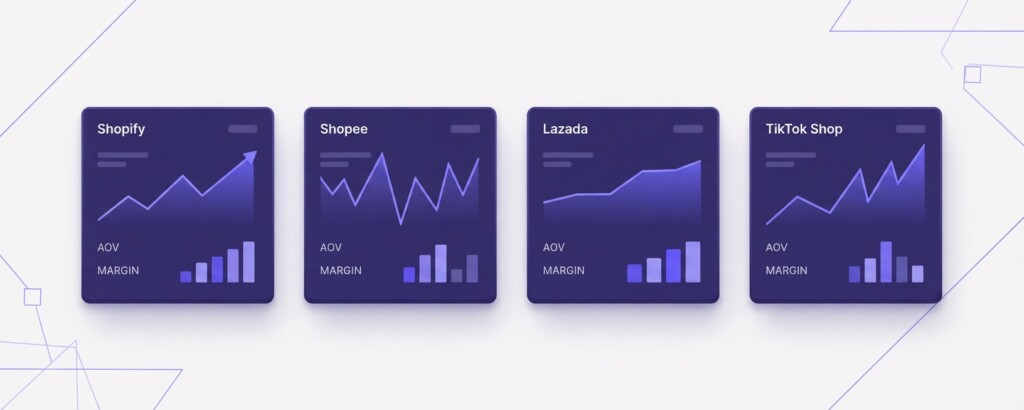
Free shipping economics vary materially across channels, and a single threshold policy applied uniformly across your business is almost always a mistake.
| Channel | Typical AOV Profile | Shipping Cost Responsibility | Key Risk |
|---|---|---|---|
| Shopify (DTC) | Operator-controlled | Seller absorbs all costs | Underpriced threshold erodes contribution margin |
| Shopee | Lower AOV, voucher-heavy | Shared; platform may subsidise | Platform campaigns can override your threshold settings |
| Lazada | Mid AOV, promo-driven | Seller-funded during campaigns | Campaign participation can trigger mandatory free shipping |
| TikTok Shop | Low AOV, impulse-driven | Seller-funded | High volume of low-value orders qualifying for free shipping |
On Shopee and Lazada, platform-level shipping subsidy programmes can partially offset your cost — but participation often comes with conditions such as minimum sales volumes or campaign fee structures. On TikTok Shop, the impulse-purchase nature of the channel means your average qualifying order may be much lower than your Shopify store, which means the same dollar threshold generates less gross profit to cover the same shipping cost.
The practical implication is that you should model your threshold independently for each channel, using that channel’s actual AOV distribution, return rate, and gross margin profile. A $50 threshold that is marginally profitable on Shopify may be significantly loss-making on TikTok Shop where the basket dynamics are completely different.
How to Test Whether Your Current Threshold Is Working
Rather than guessing, run a structured analysis against your order data. You want to answer four specific questions for each channel where you offer free shipping.
- What percentage of orders qualify for free shipping, and what is the average order value of qualifying orders?
- What is the contribution margin per qualifying order after absorbing true shipping cost — not just the carrier fee?
- What percentage of qualifying orders sit within $10 of the threshold, indicating threshold-chasing behaviour?
- What is the blended contribution margin per order across qualifying and non-qualifying orders, compared to the period before the threshold was introduced?
If contribution margin per qualifying order is negative or near zero, you are subsidising customers who would likely have purchased anyway. If the percentage of orders just above the threshold is high, customers are threshold-chasing — which is the intended behaviour — but you need to verify that the additional items they are adding carry sufficient margin to make the uplift worthwhile.
Adjusting Your Threshold: A Practical Framework
If your analysis shows the current threshold is destroying margin, you have three levers. First, raise the threshold to a level supported by your break-even formula. This will reduce the percentage of qualifying orders but should improve margin per order. Second, reduce your true shipping cost by renegotiating carrier rates, switching to poly mailers where product type allows, or optimising your pick-and-pack process. Third, adjust your product mix to push higher-margin items as add-ons for customers approaching the threshold — this improves the gross margin generated by threshold-chasing behaviour.
For multi-channel operators managing this across Shopify, Shopee, Lazada and TikTok Shop simultaneously, consolidating your channel-level contribution margin data into a single view is essential. Tools like BrizoMarket allow you to pull together order-level margin data across channels so you can see which channel’s free shipping threshold is working and which is contracting your overall profitability — rather than relying on each platform’s native analytics, which typically shows revenue without true cost visibility.
The Margin Impact of Getting This Wrong
To illustrate the scale of the problem, consider a business shipping 3,000 orders per month, with 60% qualifying for free shipping. At 1,800 qualifying orders per month, a margin shortfall of just $3.00 per order — easily achievable with an underpriced threshold — represents $5,400 per month in destroyed margin, or $64,800 per year. That is not a rounding error. It is a structural profitability problem that compounds across every promotional period when free shipping qualification typically spikes.
Recalculate your free shipping break-even threshold quarterly. Carrier rates, packaging costs and labour costs all shift, and a threshold that was correctly priced six months ago may now be under-priced as your cost base has changed.
Key Takeaways and Next Steps
Free shipping thresholds can increase both conversion and AOV — but only improve net margin when the threshold is set above the break-even point calculated from your true shipping cost and gross margin percentage. The carrier invoice is not your shipping cost. Your threshold should not be the same across every channel. And the AOV lift a threshold generates only improves margin if the incremental gross profit on the uplift exceeds the shipping cost you are absorbing.
- Calculate your true cost per shipped order including labour, packaging, and a return handling allocation.
- Apply the break-even threshold formula for each channel separately using that channel’s actual gross margin.
- Segment your order history to identify what proportion of qualifying orders are threshold-chasing versus organic.
- Model the full margin impact — not just AOV movement — before and after the threshold was introduced.
- Review and recalculate thresholds quarterly as cost inputs change.
See Your True Shipping Cost Across Every Channel
BrizoMarket consolidates your order and cost data across Shopify, Shopee, Lazada and TikTok Shop so you can calculate contribution margin per channel and model the real impact of your free shipping thresholds — before they damage your profitability.