How to Use Lazada Seller Centre Campaign Performance Reports to Calculate the True ROI of Joining a Mega Sale Event
Joining a Lazada Mega Sale — whether that is 11.11, 12.12, or a mid-year campaign — can feel like a commercial obligation rather than a deliberate business decision. The pressure to participate is real: your competitors are in, the platform promotes participating sellers more aggressively, and the traffic volumes are genuinely exceptional. But for multi-channel sellers managing margins across Shopee, TikTok Shop, and their own Shopify store, blindly joining every Lazada campaign without measuring the actual return is a fast route to revenue growth that quietly destroys profitability.
This article walks through how to use Lazada Seller Centre’s Campaign Performance Reports to calculate the true ROI of a Mega Sale event — not just the top-line GMV figure that platforms love to highlight, but the contribution margin impact that actually matters to your business.
Why GMV Is a Misleading Headline Metric for Mega Sales
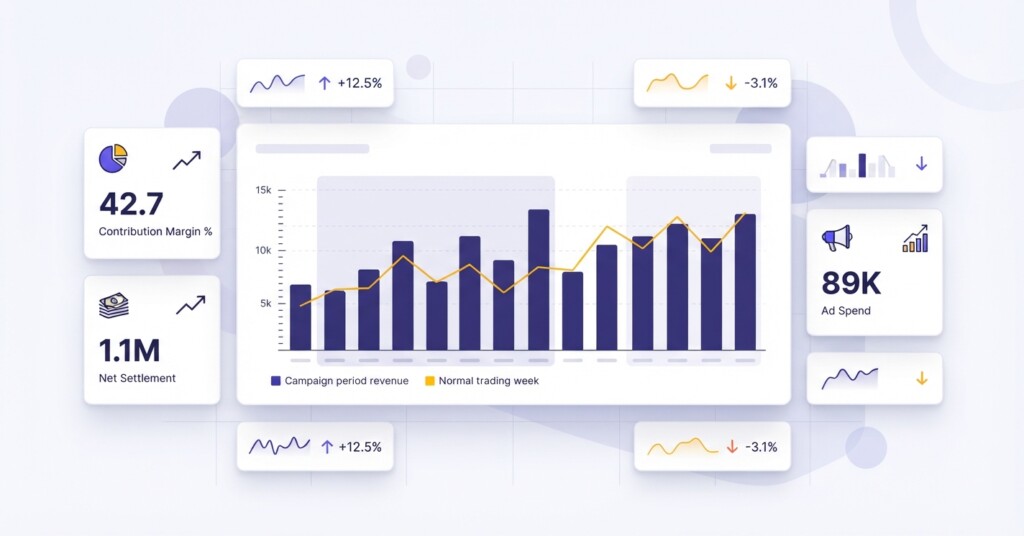
Lazada’s campaign dashboards surface GMV prominently. After an 11.11 event, you might see that your store generated three times your normal weekly revenue in a single day. That number feels good, but it does not tell you whether you made money.
GMV counts the full transaction value before any deductions. It does not account for: the deeper discounts you offered to qualify for the campaign voucher pool, the incremental LazMall or platform commission on higher-volume tiers, the sponsored search and display ad spend you ran to compete for visibility during peak traffic, returns and cancellations that often spike after sale events, or the cost of additional fulfilment, packaging, and customer service for a compressed order volume.
The most useful question to ask after any Mega Sale is not ‘How much did we sell?’ but ‘How much did we keep?’ That requires moving from GMV to contribution margin — revenue minus all variable costs directly attributable to the campaign.
Where to Find the Right Data in Lazada Seller Centre
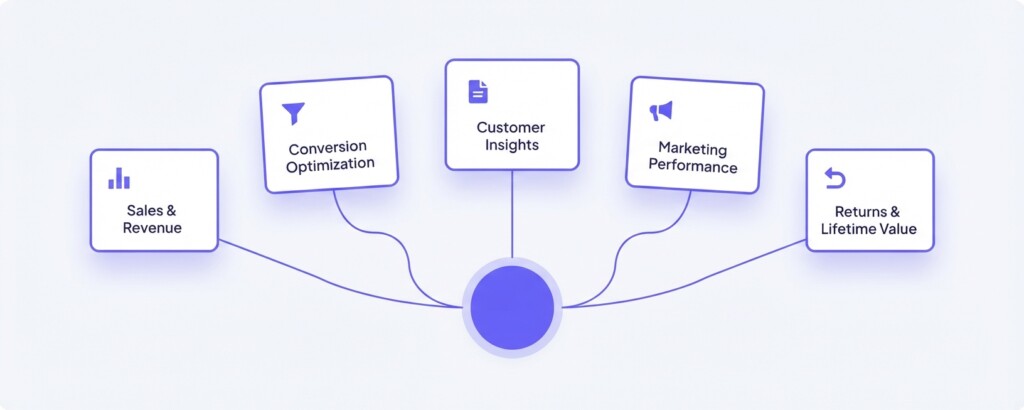
Lazada Seller Centre provides dedicated operational and financial analytics tooling. The reports you need are located across key navigation areas: Business Advisor, Marketing Center, Orders, and Finance. Here is what each contains and why it matters.
- Business Advisor > Dashboard (Sales Overview): Shows orders, units sold, GMV, and average order value for any selected date range. Set the campaign period plus 7 days post-event to capture delayed returns.
- Marketing Center > Campaign (Campaign Performance): Breaks down impressions, clicks, conversion rate, and GMV specifically attributed to the campaign after the event closes.
- Finance > Transaction Overview (or Account Statement): The most important report for ROI analysis. It shows net settlement amounts after platform fees, voucher subsidies borne by the seller, and returns.
- Sponsored Solutions > Data Reports (Ads Performance): Shows your ad spend, impressions, clicks, and attributed orders for any Lazada Sponsored Products or Display campaigns you ran during the event.
- Orders > Return Orders & Cancellations: Accessible under Orders. Filter by the post-campaign window (typically 7–14 days) to capture event-related returns.
Building the True ROI Calculation: A Step-by-Step Framework
The following framework uses a realistic example: a seller running a consumer electronics accessories brand across Lazada, Shopee, and a Shopify direct-to-consumer store. They participated in Lazada’s 11.11 Mega Sale and want to evaluate whether the campaign was worth it.
Start by pulling the Finance Transaction Overview report for the campaign period (1–11 November in this case, with a post-event window to 25 November for returns). The settlement amount shown in that report is your net platform revenue — what Lazada actually remits to you after commission, payment processing fees, and any platform-funded versus seller-funded voucher splits.
Next, identify your campaign-specific cost of goods sold (COGS). If you offered a 20% discount to qualify for the campaign voucher pool, your effective product margin is already compressed before any other costs hit. Calculate COGS at the discounted selling price, not your normal price.
| Metric | Normal Week | 11.11 Campaign Period | Notes |
|---|---|---|---|
| Gross GMV | MYR 18,500 | MYR 74,200 | Before fees and returns |
| Platform Commission (6%) | MYR 1,110 | MYR 4,452 | Applied to gross item sales |
| Payment Fee (2%) | MYR 370 | MYR 1,484 | Applied to customer payment value |
| Seller-Funded Vouchers | MYR 0 | MYR 6,850 | Campaign entry requirement |
| Returns & Cancellations | MYR 520 | MYR 5,190 | Higher post-event return rate |
| Net Platform Revenue | MYR 16,500 | MYR 56,224 | What Lazada actually remits |
| COGS (at campaign price) | MYR 8,250 | MYR 33,734 | ~45% blended COGS on GMV |
| Ad Spend (Sponsored) | MYR 400 | MYR 5,800 | Significantly increased for event |
| Fulfilment & Packaging | MYR 925 | MYR 4,510 | Per-order cost x volume |
| Gross Contribution | MYR 6,925 | MYR 12,180 | Net revenue minus all variable costs |
| Contribution Margin % (on Net Revenue) | 42.0% | 21.7% | Compressed during event (or 37.4% vs 16.4% on GMV) |
In this example, the campaign generated more absolute contribution (MYR 12,180 versus MYR 6,925 in a normal week), but at a dramatically compressed margin rate of 21.7% compared to 42.0% normally when evaluated against net platform revenue (or 16.4% compared to 37.4% when evaluated against gross GMV). Whether that trade-off is acceptable depends on your business model, your inventory turnover objectives, and your customer acquisition strategy — but you can only make that judgement if you run this calculation.
Calculating Campaign ROI and ROAS
With the contribution margin established, you can now calculate two key measures: campaign ROI and Return on Ad Spend (ROAS). These are distinct and both matter.
| Net Platform Revenue (campaign period) | MYR 56,224 |
| Less: COGS at campaign price | – MYR 33,734 |
| Less: Ad Spend (Sponsored Solutions) | – MYR 5,800 |
| Less: Fulfilment & Packaging | – MYR 4,510 |
| Campaign Contribution Margin | MYR 12,180 |
| Total Campaign Investment (Ad Spend + Vouchers) | MYR 12,650 |
| Incremental Contribution vs Normal Week | MYR 5,255 |
| Campaign ROI on Incremental Contribution | 41.5% |
| ROAS (Net Revenue / Ad Spend Only) | 9.7x |
A ROAS of 9.7x sounds excellent. But when you include the seller-funded voucher cost as part of your true campaign investment — which it genuinely is, since it was a cost of participating — the incremental ROI on total campaign spend is 41.5%. That is positive, but not the windfall the GMV headline suggested.
Do not calculate ROAS using only your Sponsored Solutions ad spend as the denominator. Seller-funded vouchers, flash sale discounts, and bundle pricing concessions are all real costs of your campaign participation. Excluding them inflates your apparent return and leads to overcommitment in future events.
Adjusting for the Cannibalization Effect Across Channels
For multi-channel sellers, the Lazada Mega Sale calculation does not end with Lazada. You need to check whether your 11.11 campaign on Lazada pulled sales forward or cannibalised revenue on Shopee, TikTok Shop, or your Shopify store.
Pull your channel-level revenue for the week of 11.11 and compare it to the preceding four weeks averaged. In the same example above, the seller saw Shopee revenue drop 28% during the campaign week, and Shopify DTC dropped 19%. Some of that is seasonal — customers consolidating purchases into the Lazada event — but it represents foregone margin on channels where the seller was not paying voucher subsidies or elevated ad costs.
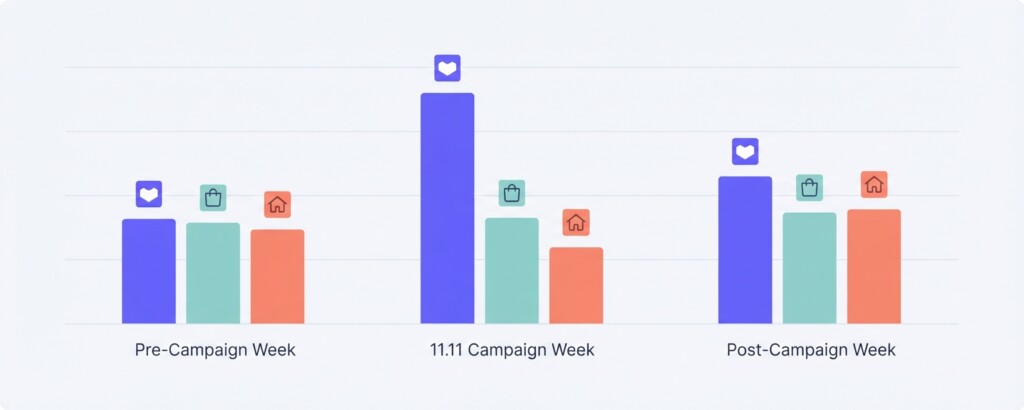
A simple cannibalization adjustment is to subtract the estimated contribution margin lost on other channels from your Lazada campaign contribution. If Shopee normally generates MYR 9,200 contribution in a week and it dropped to MYR 6,624, you lost approximately MYR 2,576 in contribution from that channel during the same period. That figure should flow into your total campaign ROI assessment.
What a Positive ROI Does Not Automatically Justify
Even if your campaign ROI is positive, there are scenarios where participating in every Mega Sale is the wrong decision for your business.
- Inventory liquidation trap: If your best-selling, highest-margin SKUs sell out during the campaign at discounted prices, you may face stock-outs at full price for weeks afterward — losing high-margin sales to fund a low-margin event.
- Brand positioning erosion: Repeated deep discounting on Lazada trains customers to wait for sales events, which structurally compresses your normal-period conversion rate over time.
- Operational stress cost: A compressed spike in orders increases error rates, customer service load, and logistics cost in ways that are hard to fully capture in a spreadsheet but are real costs nonetheless.
- Working capital strain: Lazada’s settlement cycle means your cash is tied up for days after the event, even as you needed cash to fund the inventory build-up in advance.
Making the Decision Framework Repeatable
The goal is not to do this analysis once after 11.11 and file it away. The value comes from building a repeatable pre-campaign and post-campaign evaluation process so that each Mega Sale decision is data-driven rather than instinctive.
Before each campaign, model your expected contribution margin at the proposed discount depth. Set a minimum acceptable contribution margin threshold — for most product categories, dropping below 15% contribution margin on a campaign is a signal to renegotiate participation terms or opt out of certain mechanic tiers.
After each campaign, run the full calculation within 30 days while the data is fresh and before the next campaign cycle begins. For sellers managing this across Lazada, Shopee, TikTok Shop, and Shopify simultaneously, consolidating this data manually is time-consuming. This is where a tool like BrizoMarket can help — it connects your channel data and surfaces contribution margin by channel and by campaign period, so you are not rebuilding the analysis in spreadsheets every time.
Key Takeaways and Next Steps
Lazada Mega Sales can generate meaningful incremental contribution — but only if you measure them correctly. GMV is a vanity metric for this purpose. The Finance Transaction Overview, Campaign Performance reports, and Data Reports for ads together give you the inputs you need. Add your COGS at campaign price, fulfilment costs, and seller-funded voucher value, and you have a true contribution margin picture.
Factor in cross-channel cannibalization before declaring a campaign a success. A Lazada campaign that generates MYR 12,000 in contribution while suppressing MYR 8,000 in contribution from other channels is a much less compelling result than the Lazada dashboard alone will show you.
Build this analysis as a standard operating procedure, not a one-off exercise. The sellers who consistently win on Lazada Mega Sales are not the ones who participate in every event — they are the ones who know exactly which events, which SKUs, and which discount depths work for their margin structure.
Analyse Your Campaign ROI Across Every Channel
BrizoMarket helps multi-channel sellers consolidate Lazada, Shopee, TikTok Shop, and Shopify data to measure true contribution margin and campaign ROI — without rebuilding spreadsheets after every sale event.