How to Calculate True Profitability on Shopee After Fees, Vouchers, and Shipping Subsidies

Shopee is one of the most active marketplaces in Southeast Asia, and for many e-commerce businesses it drives significant order volume. But high sales numbers on Shopee can be deeply misleading. Once you account for platform commission fees, transaction charges, seller-funded vouchers, free shipping subsidies, and returns, what looked like a healthy revenue line can quietly erode into a loss-making channel. This article walks through a structured method for calculating your true profitability on Shopee — the kind of number that actually matters when making decisions about pricing, promotions, and channel investment.
Why Shopee Revenue Is Not the Same as Shopee Income
Many sellers monitor their Shopee dashboard and see gross merchandise value (GMV) — the total value of orders placed. This is not the money you receive, and it is not a measure of profitability. Between GMV and actual cash in your account, Shopee deducts a range of charges that vary by product category, promotional participation, and seller tier.
The core deductions to understand are: commission fees (a percentage of the selling price), transaction fees (payment processing), campaign voucher co-funding (your share of discount codes issued during campaigns), service and free shipping fees, and return-related losses. Each of these reduces the net amount Shopee remits to you, but they do not always appear as a clean line item in your seller centre reports.
The key distinction to internalise: Shopee pays you net of its own deductions, but it does not automatically show you the full cost breakdown. You need to reconstruct your true economics from the income statement, fee schedules, and campaign participation agreements.
The Shopee Profitability Formula
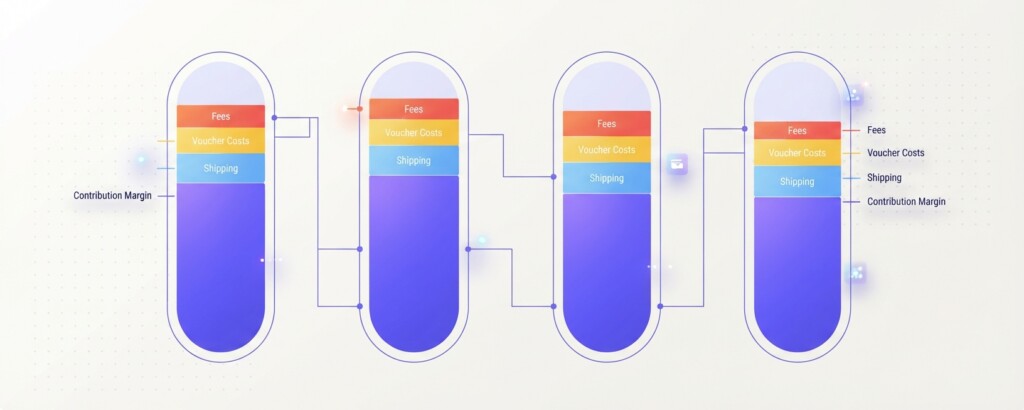
To calculate true profitability on Shopee for any product or order, you need to work through a layered formula. Start with the selling price, then strip out every cost that touches that sale before you reach contribution margin — the amount each unit actually contributes to covering your overheads and generating profit.
| Selling Price (listed price on Shopee) | RM 120.00 |
| Less: Seller-Funded Voucher Discount (e.g. 10% off voucher co-funded by seller) | – RM 12.00 |
| Net Selling Price | RM 108.00 |
| Less: Shopee Commission Fee (e.g. 5.5% of net selling price) | – RM 5.94 |
| Less: Shopee Transaction Fee (e.g. 2% of net selling price) | – RM 2.16 |
| Less: Free Shipping Subsidy Absorbed by Seller | – RM 8.00 |
| Gross Remittance from Shopee | RM 91.90 |
| Less: Cost of Goods Sold (COGS) | – RM 48.00 |
| Less: Packaging and Fulfilment Cost | – RM 4.50 |
| Contribution Margin per Unit | RM 39.40 |
In this example, the listed price is RM 120, but after all Shopee-related deductions and direct costs, the contribution margin is RM 39.40 — a contribution margin rate of approximately 32.8% on the listed price, or 36.5% on the net selling price. That is a reasonable margin for some categories, but it may be far lower than what a seller assumes when they look only at their Shopee revenue report.
Breaking Down Each Cost Component
Understanding where each deduction comes from helps you model different scenarios and make more informed decisions about pricing, campaign participation, and product selection.
| Cost Component | Typical Range | Seller Control | Notes |
|---|---|---|---|
| Commission Fee | 4% – 12%+ | Low | Set by Shopee per category; varies by seller tier and Mall status |
| Transaction / Payment Fee | 3.5% – 5% | None | Applied to final order amount paid by buyer including shipping and SST |
| Seller-Funded Voucher | 5% – 20%+ | High | Seller opts in to campaigns; discount is partially or fully seller-funded |
| Free Shipping Subsidy | Fixed or 3% – 6% | Medium | Depends on programme participation; charged via service fee or seller-absorbed shipping |
| Return Losses | Variable | Low | Lost fulfilment costs and possible stock damage on returned items |
| Advertising (Shopee Ads) | Variable by bid | High | Not deducted from remittance but a real cost to factor into contribution margin |
Shopee Ads spend deserves special mention. It does not appear in your remittance deductions — you pay it separately — but it is absolutely a cost of generating sales on Shopee. If you spent RM 400 on Shopee Ads to generate RM 2,000 in GMV, that is a 20% additional cost load on top of everything else. Always include ad spend when calculating channel-level profitability.
Vouchers and Campaign Participation: The Hidden Margin Killers
Shopee runs frequent campaigns — 9.9, 10.10, 11.11, 12.12, and various flash sale events. Participating in these campaigns can drive significant order volume, but the terms often require sellers to fund a portion of the discount offered to buyers. This co-funding arrangement is frequently misunderstood.
When a buyer uses a Shopee-issued voucher, Shopee may fund part of it. When a seller issues a shop voucher or participates in a campaign bundle discount, the seller funds it entirely. In many campaigns, the seller is required to offer a minimum discount percentage as a condition of being featured. If your product was already priced with tight margins, this mandatory discount can push the unit into unprofitable territory.
Before joining any Shopee campaign, calculate the contribution margin at the required discount level, not at your standard price. A product that earns RM 35 contribution margin at full price may earn RM 8 — or lose money — at the campaign discount, once fees and shipping are applied. Many sellers discover this only after the campaign ends and reconcile their income statement.
Shipping Subsidies: Who Actually Pays?
Free shipping is a major driver of purchase conversion on Shopee. Buyers strongly prefer ‘free shipping’ listings. However, ‘free’ for the buyer does not mean zero cost for the seller. Shopee operates several free shipping programmes, and the seller typically absorbs some portion of the shipping charge, either through programme service fees, seller-funded shipping promotions, or reduced remittance.
The exact structure depends on your market, seller tier, and the specific programme you have joined. In many cases, Shopee subsidises a portion of shipping for buyers via Free Shipping programmes, for which sellers pay an opt-in service fee. Furthermore, shipping subsidies are capped by parcel weight, dimensions, and tier. If an order exceeds the subsidy cap, the remaining logistics fee is either borne by the buyer or absorbed by the seller via seller-funded shipping promotions.
For light items — cosmetics, accessories, small electronics — the shipping subsidy structure usually works in the seller’s favour. For heavier products, it can be a significant cost. Model this carefully for each product category you sell.
Building a Product-Level Profitability View
The most useful unit of analysis is the individual product or SKU. Aggregate channel-level P&L figures hide which products are actually profitable and which are subsidising underperformers. Here is a simple framework for reviewing Shopee profitability at product level.
- Export your Shopee income statement for the period — this shows gross remittance and any deductions applied at order level.
- Map each order line to a SKU and record the selling price, any voucher applied, and the remittance received.
- Add COGS per unit from your inventory records or purchase orders.
- Add fulfilment costs: packaging materials, pick-and-pack labour, and any shipping absorbed.
- Add a proportional share of your Shopee Ads spend, allocated to the SKUs those ads generated sales for.
- Calculate contribution margin per unit and contribution margin rate for each SKU.
- Rank your SKUs by contribution margin rate and by absolute contribution margin generated in the period.
- Identify SKUs with negative or near-zero contribution margin — these require a pricing review or should be exited from campaign participation.
Comparing Shopee Profitability Against Other Channels
Once you have a reliable contribution margin figure for Shopee, you can compare it against your other channels using the same methodology. This comparison often produces surprising results. A product that earns a 28% contribution margin on Shopee might earn 42% on your Shopify direct store — because there are no marketplace commission fees, and you control your own promotions without mandatory discounts.
| Channel | Selling Price | Platform Fees | Voucher Cost | Shipping Cost | COGS + Fulfilment | Contribution Margin | CM Rate |
|---|---|---|---|---|---|---|---|
| Shopee | RM 120 | RM 8.10 | RM 12.00 | RM 8.00 | RM 52.50 | RM 39.40 | 32.8% |
| Lazada | RM 120 | RM 9.60 | RM 6.00 | RM 6.00 | RM 52.50 | RM 45.90 | 38.3% |
| TikTok Shop | RM 115 | RM 7.48 | RM 11.50 | RM 7.00 | RM 52.50 | RM 36.52 | 31.8% |
| Shopify (direct) | RM 130 | RM 3.90 | RM 0 | RM 9.00 | RM 52.50 | RM 64.60 | 49.7% |
This kind of cross-channel comparison immediately changes how you think about channel strategy. Shopee may drive the highest order volume, but if your Shopify store is generating almost 50% contribution margin on the same product, the business case for investing more in direct-to-consumer acquisition becomes clear — even if absolute sales volumes are lower.
Using Analytics Tools to Automate This Process
Manually calculating contribution margin per SKU across thousands of orders per month is not sustainable. Most sellers start in spreadsheets and quickly hit the limits of that approach — particularly when they are operating across Shopee, Lazada, TikTok Shop, and Shopify simultaneously, each with different fee structures, currency considerations, and reporting formats.
Purpose-built e-commerce analytics platforms can consolidate your sales data across channels and apply cost models that reflect real-world fees, COGS, and fulfilment costs. BrizoMarket, for example, is designed specifically for multi-channel e-commerce sellers and lets you define your cost structure per channel so that contribution margin is calculated automatically at the order and product level — without manual reconciliation from each platform’s income statement.
The operational benefit is speed: instead of spending two days reconciling Shopee fees after a campaign, you have an up-to-date view of which products made money and which did not, so you can act on it before the next campaign cycle begins.
Practical Next Steps
If you have never done a full cost-through profitability analysis on your Shopee channel, the following steps will give you a clear starting point. You do not need sophisticated software to get started — a disciplined spreadsheet built around the formula above will show you what you need to know.
- Download your last 90 days of Shopee income statements and identify the total fees, voucher co-funding, and shipping absorbed.
- Select your top 10 SKUs by GMV and calculate contribution margin per unit using the formula in this article.
- Flag any SKU where contribution margin rate falls below 20% — this is your threshold for a pricing or campaign review.
- Calculate the effective ad cost per order for any SKU you are running Shopee Ads on, and add this to the cost model.
- Run the same analysis for the same SKUs on each other channel you sell through and build a side-by-side comparison.
- Use the results to make one concrete decision: which SKUs to exclude from the next Shopee campaign, or which channel to prioritise for a new product launch.
True profitability on Shopee is not a number the platform hands you. It is a number you have to build yourself — by understanding the full cost structure, modelling it at product level, and comparing it honestly against your other channels. The sellers who do this consistently make better decisions about pricing, campaigns, and where to focus their growth investment.
Calculate Your True Channel Profitability Across Every Platform
BrizoMarket helps multi-channel e-commerce businesses track contribution margin, fees, and product-level profitability across Shopee, Lazada, TikTok Shop, and Shopify — without manual reconciliation.