How to Calculate True Profitability on Lazada After Commission Fees, Vouchers, and Shipping Subsidies
Most Lazada sellers look at their dashboard revenue and assume that number represents what they earned. It does not. Between platform commissions, voucher subsidies, shipping fee offsets, payment processing charges, and promotional co-funding, the actual cash that flows through to your business can be significantly lower than the gross merchandise value (GMV) your seller centre reports. If you are managing a multi-channel operation across Lazada, Shopee, Shopify, or TikTok Shop, using the wrong revenue figure as your baseline will distort every margin calculation you make.
This article walks through a structured method for calculating true profitability on Lazada, using realistic line-item deductions and worked examples. By the end, you will have a framework you can apply to every Lazada order, product category, and promotional campaign.
Why Lazada Revenue Is Not the Same as Lazada Income
Lazada reports GMV — the gross merchandise value before seller discounts and vouchers — as your top-line figure. But your actual income is net of several deductions that Lazada processes on its side before you receive a payout. These deductions include commission fees (which vary by category), payment processing fees, shipping subsidies you contribute to, voucher co-funding, and any LazCoins or cashback promotions you participate in.
On top of platform deductions, you still carry your own cost of goods sold (COGS), fulfilment handling costs, return and refund losses, and any off-platform marketing spend. Sellers who calculate margins using GMV as the revenue figure routinely overestimate profitability by 15 to 40 percentage points, depending on their category and promotional activity.

The Lazada Deduction Stack: What Gets Taken Before You Are Paid
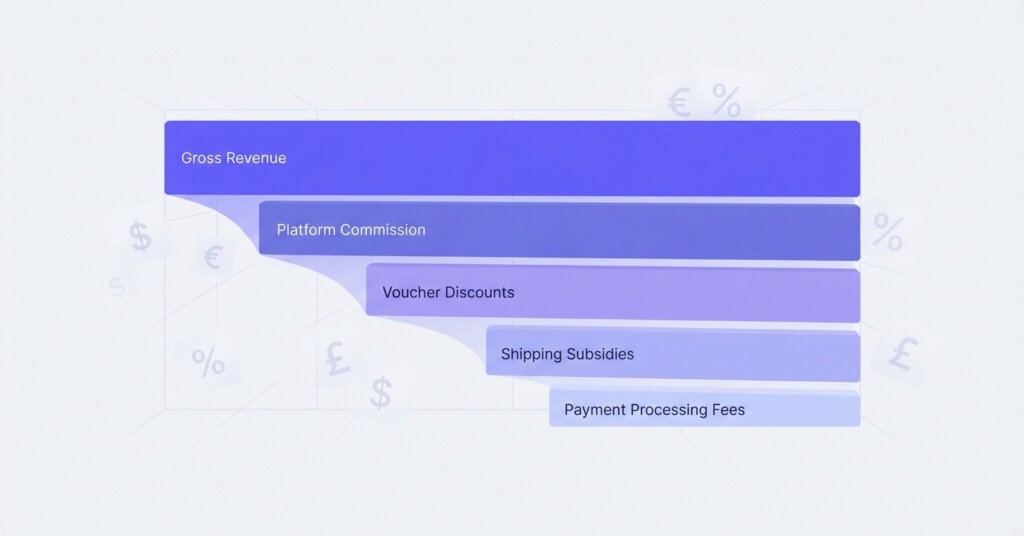
To build an accurate profitability model, you need to understand each layer of deduction in sequence. Think of this as a revenue waterfall — each step reduces what you actually receive.
- Gross Merchandise Value (GMV): The total listed value of merchandise ordered, before seller discounts or inclusive of platform voucher discounts applied at checkout.
- Platform Commission Fee: A percentage deducted based on your product category. Rates vary across categories — electronics tends to sit lower, while fashion and beauty often attract higher rates — and are subject to local taxes such as SST.
- Payment Processing Fee: A percentage applied to the final transaction value (typically around 3.5% plus SST in Malaysia, or 2% in Singapore), separate from commission.
- Shipping Fee Subsidy: If you are running free-shipping promotions or participating in Lazada shipping programmes, a portion of the shipping cost may be charged back to you.
- Voucher Co-Funding: When seller-funded or co-funded vouchers are redeemed, the discount amount is deducted from your payout, not covered by Lazada.
- Return Deductions: Refunded orders result in reversal of the associated payout, and in some cases handling fees still apply.
The distinction between platform-funded and seller-funded vouchers is critical. When a buyer uses a Lazada platform voucher, Lazada absorbs the cost. When a buyer uses a store voucher you created, the deduction comes out of your payout. Always check whether your promotions are co-funded or fully seller-funded before calculating margins.
A Worked Example: Calculating True Profitability on a Single Lazada Order
Let us use a practical example. You sell a skincare set at a listed price of RM 120. A buyer purchases one unit during a campaign and redeems a seller-funded RM 10 store voucher, paying RM 110 at checkout. Here is what happens to that RM 110 before it reaches you.
| Buyer-facing selling price (GMV) | RM 120.00 |
| Seller-funded store voucher deducted | – RM 10.00 |
| Net order value (what Lazada processes) | RM 110.00 |
| Platform commission fee (approx. 7% on RM 110) | – RM 7.70 |
| Payment processing fee (approx. 2% on RM 110) | – RM 2.20 |
| Shipping subsidy contribution (seller portion) | – RM 5.00 |
| Net payout received from Lazada | RM 95.10 |
Now subtract your own costs against that RM 95.10 payout.
| Net payout from Lazada | RM 95.10 |
| Cost of goods sold (COGS) | – RM 45.00 |
| Packing and handling cost | – RM 3.50 |
| Allocated seller-side marketing spend (Lazada Sponsored) | – RM 8.00 |
| True Contribution Margin | RM 38.60 |
Your contribution margin on this order is RM 38.60 — or 32.2% of the original listed price. If you had calculated margins using the listed GMV of RM 120 and only subtracted COGS, you would have reported a margin of 62.5%. That is a significant overstatement that leads to poor pricing decisions, over-investment in promotions, and incorrect channel comparisons.
Comparing Lazada True Margin Against Other Channels
Once you have a true margin figure for Lazada, the next step is comparing it against your other sales channels using the same methodology. Many multi-channel sellers discover that their Lazada and Shopee margins differ substantially despite similar listed prices — because commission structures, shipping programmes, and promotional mechanisms are not identical.
| Metric | Lazada | Shopee | TikTok Shop | Shopify (DTC) |
|---|---|---|---|---|
| Listed price | RM 120 | RM 120 | RM 120 | RM 120 |
| Typical commission rate | ~5–8% | ~4–9% | ~4–10% (varies) | 0% (own store) |
| Payment processing fee | ~2–3.5% | ~2–3.5% | ~2–3.5% | ~2–3% (gateway) |
| Shipping subsidy (seller portion) | RM 5.00 | RM 4.00 | RM 3.50 | RM 8.00 (own courier) |
| Estimated net payout (before COGS) | RM 95.10 | RM 97.20 | RM 99.50 | RM 106.40 |
| COGS | RM 45.00 | RM 45.00 | RM 45.00 | RM 45.00 |
| Contribution margin (after COGS) | RM 50.10 | RM 52.20 | RM 54.50 | RM 61.40 |
| Contribution margin % | 41.8% | 43.5% | 45.4% | 51.2% |
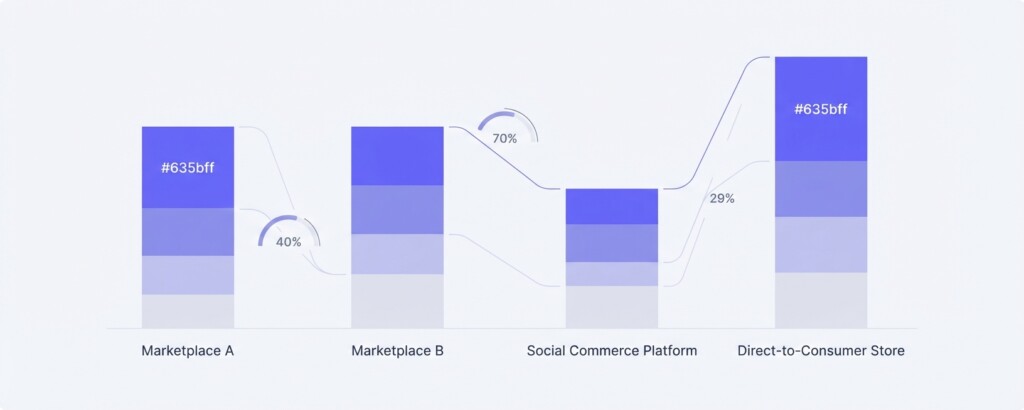
The table above uses indicative rates for illustration. Your actual rates will depend on your product category, seller tier, prevailing tax rates (such as 8% SST in Malaysia), and negotiated terms. The key insight is that your Shopify direct-to-consumer channel typically produces the highest contribution margin — but it also requires you to drive your own traffic and absorbs its own marketing costs. True channel comparison must include your allocated marketing spend per channel, not just platform fee differences.
How Vouchers and Promotions Distort Your Numbers During Campaigns
Campaign periods such as 11.11, 12.12, and mid-month flash sales typically show a spike in order volume on Lazada — but contribution margins during these periods often compress significantly. This happens because multiple discount layers stack on top of each other: seller-funded vouchers, Lazada platform vouchers, bundle discounts, and coin cashback all interact on a single transaction.
During major Lazada campaigns, it is common for sellers to see GMV increase by 200–400% while their actual net payout per unit decreases by 20–35% compared to a normal trading day. If you are measuring campaign success purely by GMV or order count, you may be celebrating a campaign that actually damaged your profitability. Always calculate contribution margin per campaign period separately from your baseline trading period.
To manage this, build a campaign profitability template that captures: your listed price during the campaign, each discount type applied and whether it is seller-funded or platform-funded, your expected commission and payment fee rates, your incremental fulfilment costs during high-volume periods, and your pre- and post-campaign return rate (since impulse purchases during campaigns tend to return at higher rates).
Building a Lazada Profitability Tracking Model
Rather than calculating profitability order by order, the most practical approach is to build a product-level profitability model that you update monthly. Here is a framework for structuring it.
- Export your Lazada Seller Centre financial report for the period, which includes order-level payout figures after deductions.
- Cross-reference against your order management system or 3PL records to allocate COGS and handling costs per SKU.
- Segment data by product category and campaign vs. non-campaign periods.
- Calculate contribution margin per SKU: Net payout minus COGS minus handling minus allocated marketing spend.
- Identify your top 10 SKUs by volume and compare their contribution margins. Many sellers find their highest-volume products are not their most profitable.
- Calculate a blended return rate per category and adjust your effective payout downward accordingly.
- Review your seller-funded voucher redemption report to understand the true cost of store discounts.
Using Analytics Tools to Automate the Calculation
Doing this manually across thousands of orders and multiple channels is time-consuming and error-prone. This is where a purpose-built analytics platform becomes genuinely useful. BrizoMarket, for example, is designed to pull in multi-channel order and financial data — including Lazada — and calculate contribution margin at the product and channel level automatically, factoring in platform fees, fulfilment costs, and marketing spend. Rather than building spreadsheets from raw exports, operators can view profitability by SKU, campaign, or channel in a single dashboard.
Whether you use a dedicated tool or a well-structured spreadsheet model, the principle is the same: your profitability analysis must start from net payout, not GMV, and must include every cost layer before arriving at a contribution margin you can act on.
Practical Next Steps for Lazada Sellers
- Pull your last 90 days of Lazada financial statements and identify your effective commission rate per category — this is your actual rate, not the listed rate.
- Separate campaign-period orders from baseline orders and calculate contribution margins for each period independently.
- Audit all active store vouchers to confirm which are seller-funded and quantify the monthly cost.
- Build a per-SKU profitability table using net payout figures, not GMV.
- Compare your Lazada contribution margin to at least one other channel using the same cost methodology.
- Set a minimum contribution margin threshold below which you will not run promotions or accept campaign participation — and stick to it.
A useful rule of thumb: if your Lazada contribution margin after all deductions and COGS is below 20%, examine whether your pricing, commission category classification, or promotional participation is the primary driver — and fix the most controllable variable first.
The Bottom Line
True profitability on Lazada requires working through a multi-layer deduction stack before you can trust any margin figure. Commission fees, seller-funded vouchers, shipping subsidies, and payment processing fees each reduce what you actually receive, and your own COGS and fulfilment costs determine whether what remains is genuinely profitable. Sellers who skip this analysis end up scaling products and campaigns that look strong on GMV but are quietly eroding their margins.
The framework in this article — waterfall revenue calculation, per-SKU contribution margin, campaign vs. baseline segmentation, and cross-channel comparison — gives you the structure to make better decisions about which products to prioritise, which promotions are worth running, and where your multi-channel investment is actually generating returns.
Calculate True Profitability Across Every Channel
BrizoMarket helps e-commerce operators track contribution margin, channel performance, and product profitability across Lazada, Shopee, TikTok Shop, and Shopify — without the manual spreadsheet work.